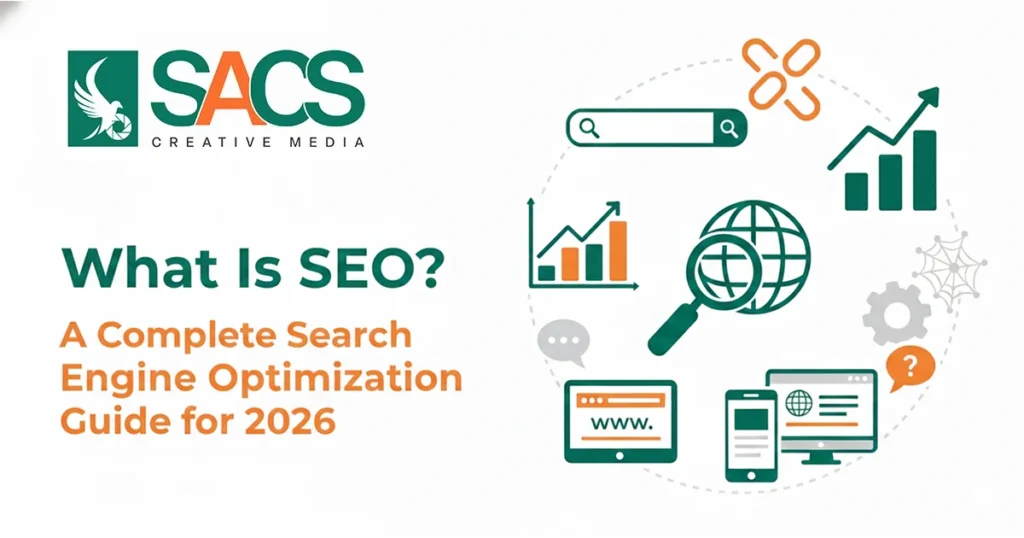
In the digital era, understanding Search Engine Optimization (SEO) is crucial for businesses looking to succeed online. From startups in Dubai to large enterprises, SEO helps improve visibility, attract relevant traffic, and convert visitors into loyal customers. This guide explains what SEO is, its main components, how it works, and the techniques you can implement in 2026 to stay ahead of the competition.
What Is SEO?
SEO stands for Search Engine Optimization, a process of enhancing your website to rank higher in organic search results on search engines like Google, Bing, and Yahoo. Unlike paid advertising, SEO focuses on driving natural traffic by improving website relevance, authority, and user experience.
In simple terms, SEO helps your website show up in the top search results when people are looking for products, services, or information related to your business. For businesses in the UAE, it’s especially crucial for reaching local customers who are actively searching online.
How Does SEO Work?
Search engines use complex algorithms to deliver the most relevant results to users. Understanding how SEO works is critical for applying effective strategies. Here’s the process simplified:
- Crawling: Search engines send bots (called crawlers or spiders) to discover web pages.
- Indexing: Discovered content is stored in a search engine’s database.
- Ranking: Algorithms evaluate the indexed content using over 200 ranking factors, such as relevance, quality, user experience, and authority.
By optimizing your website for these factors, SEO increases the chances of your content being featured prominently in search results.
Key Types of SEO
SEO can be divided into several categories, each addressing a different aspect of website optimization:
1. On-Page SEO
On-page SEO refers to optimizing elements directly on your website. This includes:
- Keyword Optimization: Using high-intent keywords such as “Search Engine Optimization techniques,” “SEO services Dubai,” and “content optimization for SEO.”
- Title Tags and Meta Descriptions: Crafting compelling titles and descriptions that improve click-through rates.
- Content Optimization: Creating informative, engaging, and unique content that satisfies user intent.
- Internal Linking: Linking to relevant pages within your website to enhance navigation and distribute authority.
2. Off-Page SEO
Off-page SEO involves external strategies that improve your website’s reputation. Key techniques include:
- Backlinks: Earning links from authoritative websites signals trust to search engines.
- Social Media Engagement: Promoting content on platforms like LinkedIn, Instagram, and Facebook.
- Online Reviews and Mentions: Positive reviews and brand mentions increase credibility in local searches.
3. Technical SEO
Technical SEO ensures that search engines can crawl and index your website efficiently. Important factors include:
- Site Speed: Faster websites improve user experience and rankings.
- Mobile Optimization: Responsive design for mobile users in UAE and worldwide.
- Secure Websites (HTTPS): Security is a ranking signal and builds trust.
- Structured Data and Schema Markup: Helps search engines understand your content better.
4. Local SEO
Local SEO is crucial for businesses targeting specific locations, such as Dubai, Abu Dhabi, or Sharjah. Strategies include:
- Google Business Profile Optimization: Ensuring accurate business information for local searches.
- Local Citations: Listing your business in online directories.
- Localized Content: Including geo-specific keywords like “SEO services Dubai” or “best restaurants in Abu Dhabi.”
5. E-commerce SEO
For online stores, optimizing product pages is essential. Key elements include:
- Product Descriptions: Clear, informative, and keyword-rich content.
- Schema Markup for Products: Helps search engines display rich snippets like price and reviews.
- User Reviews and Ratings: Encourage engagement and trust.
Search Engine Optimization Techniques for 2026
To achieve high rankings in 2026, businesses need to implement modern SEO techniques:
- Keyword Research and Optimization: Focus on high-volume, low-competition keywords while maintaining natural language.
- High-Quality Backlinks: Earn links from reputable sites within your industry.
- Content Marketing: Publish guides, blogs, and case studies that address user questions and needs.
- Technical SEO Improvements: Optimize site speed, structured data, and mobile performance.
- Local SEO Strategies: Enhance visibility for geo-targeted searches like “SEO Services in UAE.”
- User Experience Focus: Improve website layout, navigation, and interactive elements.
What changed going into 2026 (the updates that matter)
1. Search is increasingly AI-mediated
- Google’s AI Overviews expanded the “answer box” concept into multi-source AI summaries that cite websites. Google described this shift publicly and has continued to expand AI experiences in Search.
- In 2025, AI Overviews didn’t roll out in a straight line—visibility surged for a period and then pulled back, showing Google is actively tuning when and how AI answers appear.
- What it means for SEO: your job is not only to rank—it’s to be cited and trusted when AI composes answers.
2. Core updates keep rewarding “helpful, reliable, satisfying”
- Google’s ranking systems still shift through core updates (for example, the December 2025 core update ran for ~18 days).
- Google’s own guidance emphasizes analyzing impact correctly and improving content quality rather than “chasing the algorithm.”
- What it means for SEO: shortcuts don’t compound. Brand trust + content usefulness does.
3. Bing and Microsoft are also pushing generative search
- Microsoft has been expanding generative search experiences and blending classic search with AI answers.
- They’re also pushing faster indexing workflows (IndexNow) and more real-time discovery, especially for commerce.
- What it means for SEO: optimization is now multi-engine by default.
4. Quality control and “Your Money or Your Life” topics matter more
- In January 2026, reporting highlighted serious concerns when AI summaries deliver misleading health info—leading to removals for specific cases.
- What it means for SEO: for sensitive topics (health, finance, legal), “trust signals” and expert sourcing are not optional.
How to position your company inside AI platforms (ChatGPT, Gemini, Copilot-style answers) using SEO
You can’t “submit your site to ChatGPT” the way you submit a sitemap to Google. But you can shape the footprint AI systems see and cite by building a strong, consistent,
machine-readable brand presence across the web.
1. Build your “entity footprint” (Brand SEO)
AI systems don’t just read pages—they build a knowledge graph of entities (your brand, services, founders, locations, reviews, mentions).
Do this:
● Keep NAP consistency (Name, Address, Phone) everywhere
● Strengthen profiles: Google Business Profile, Bing Places, Apple Business Connect (as
relevant)
● Use the same brand description, category, services, and URLs consistently
● Collect reviews ethically and respond like a real business.
2. Make your site easy to parse and cite
● Clear H1/H2 structure
● “Quick answer” section near the top (2–4 lines)
● Add a TL;DR and a Key Takeaways box
● Use descriptive tables (not screenshot images)
3. Use structured data (Schema) where it truly fits
Schema helps engines understand what a page is (service, product, organization, FAQ, review,
location).
High-impact schema types for most service businesses:
● Organization
● LocalBusiness
● Service
● Product (if applicable)
● FAQPage (only for real FAQs)
● Article / BlogPosting
4. Publish content that AI assistants want to recommend
AI answers often cite sources that are:
● Specific and practical (not generic)
● Updated with dates and context
● Backed by experience (photos, examples, case studies)
● Trusted by others (mentions, links, reviews)
Content ideas that perform well in AI-first search:
● “Best option for X in [city]” (with transparent criteria)
● “Cost breakdown for X in 2026”
● “Mistakes to avoid when doing X”
● “Comparison: option A vs option B (with who it’s for)”
● Case studies with numbers, timelines, and deliverables
5) Win “citation signals” (digital PR meets SEO)
AI systems and search algorithms both react to authority signals:
● Earn mentions in reputable sites
● Collaborate with industry partners
● Publish original mini-research (even a small dataset is powerful)
● Sponsor or speak at community events (then get listed/linked)
The 2026 SEO pillars (what to focus on)
Pillar 1: Technical SEO (Eligibility)
If your pages can’t be crawled, nothing else matters.
Checklist:
● Fast pages (especially mobile)
● Clean indexation (no accidental noindex/canonical errors)
● XML sitemap + proper robots.txt
● Core pages reachable within a few clicks
● Fix duplicates, thin pages, broken internal links
Pillar 2: On-page SEO (Relevance)
This is “match the intent better than anyone.”
Do this:
● One page = one primary job (don’t mix too many intents)
● Add intent sections: definition → benefits → steps → cost → FAQ
● Use real language your customers use (not internal jargon)
Pillar 3: Content SEO (Value)
Google and Bing can detect content that’s “written to rank” vs “written to help.”
Content that wins in 2026:
● Experience-led content (photos, examples, workflows, templates)
● Updated annually (add “Updated: Jan 2026” with real changes)
● Focused depth (a complete guide beats 20 thin posts)
Pillar 4: Off-page SEO (Trust)
Backlinks still matter, but the right ones matter more:
● Relevant industry sites
● Local publications
● Partner mentions
● Legit directories (not spam networks)
Pillar 5: UX & Conversion (Profit)
SEO traffic is useless if it doesn’t convert.
Improve:
● Clear service pages with pricing ranges (where possible)
● Strong calls-to-action
● WhatsApp/call buttons for mobile
● Fast quote forms
● Proof (portfolio, testimonials, before/after)
Why SEO is more powerful than most marketing strategies (in 2026 terms)
SEO is not “better than everything” in every situation—but it’s often the highest compounding channel.
SEO advantages
● Compounding ROI: one good page can bring leads for years
● High intent: people search when they want something now
● Trust engine: organic results and citations feel less “pushy” than ads
● Lower marginal cost: paid ads stop the moment you stop paying
● Supports every other channel: SEO pages become landing pages for ads, social,
email, and sales
Where other channels can beat SEO
● If you need results this week, paid ads may win
● If you’re launching a new brand, influencer/social can create faster awareness
● If you sell visually-driven products, short-form video can spike demand
Best strategy in 2026: SEO as the foundation + paid/social as accelerators.
“AI SEO” workflow for your agency (practical plan you can implement)
Step 1: Define your “AI-citable” service hubs
Create 4–8 “pillar” pages like:
● SEO Services in [UAE/Dubai/Abu Dhabi]
● Social Media Management for [industry]
● Video Production for [industry]
● Web Design for [industry]
Each hub must include:
● 2–4 line summary
● What’s included (bullets)
● Process (step-by-step)
● Proof (portfolio + mini case studies)
● FAQs (real customer questions)
Step 2: Build supporting clusters
For each hub, publish 6–12 supporting articles:
● Pricing guides
● Mistakes
● Comparisons
● Checklists
● Industry-specific guides
Step 3: Add structured data + entity consistency
● Organization + LocalBusiness schema
● Service schema on service pages
● Consistent NAP across the web
Step 4: Create “citation magnets”
Once per quarter, publish something original:
● A benchmark report
● A trends roundup with your own analysis
● A mini study (even 50 samples is content people cite)
Step 5: Track AI visibility (not just rankings)
In 2026, measure:
● Organic leads & assisted conversions
● Brand searches growth
● Mentions and links
● Queries that trigger AI answers (and whether you appear as a cited source)
The biggest SEO mistakes in 2026 (and what to do
instead)
1. Publishing generic AI-written blogs
Instead: AI-assisted drafts + human experience + real examples
2. Targeting only “high volume” keywords
Instead: target high-intent, close-to-buy keywords and local modifiers
3. Ignoring brand/entity building
Instead: treat your brand presence like a product—consistent everywhere
4. Writing without structure
Instead: make content “answer-ready” (definitions, steps, FAQs, comparisons)
5. Chasing every algorithm rumor
Instead: follow official guidance and improve usefulness and trust.
Conclusion
Search Engine Optimization (SEO) is the cornerstone of digital marketing success in 2026. From small businesses in Dubai to multinational corporations, optimizing your website for search engines ensures long-term growth and visibility. By implementing on-page, off-page, technical, local, and e-commerce SEO strategies, and staying ahead of evolving trends, businesses can thrive in an increasingly competitive online landscape.
Invest in Best SEO services in Dubai , UAE to create content that ranks, engages, and converts. The right SEO strategy is no longer optional—it’s the foundation of a sustainable online presence.
Take action today: audit your website, optimize your content, and watch your business climb the search rankings in 2026 and beyond.