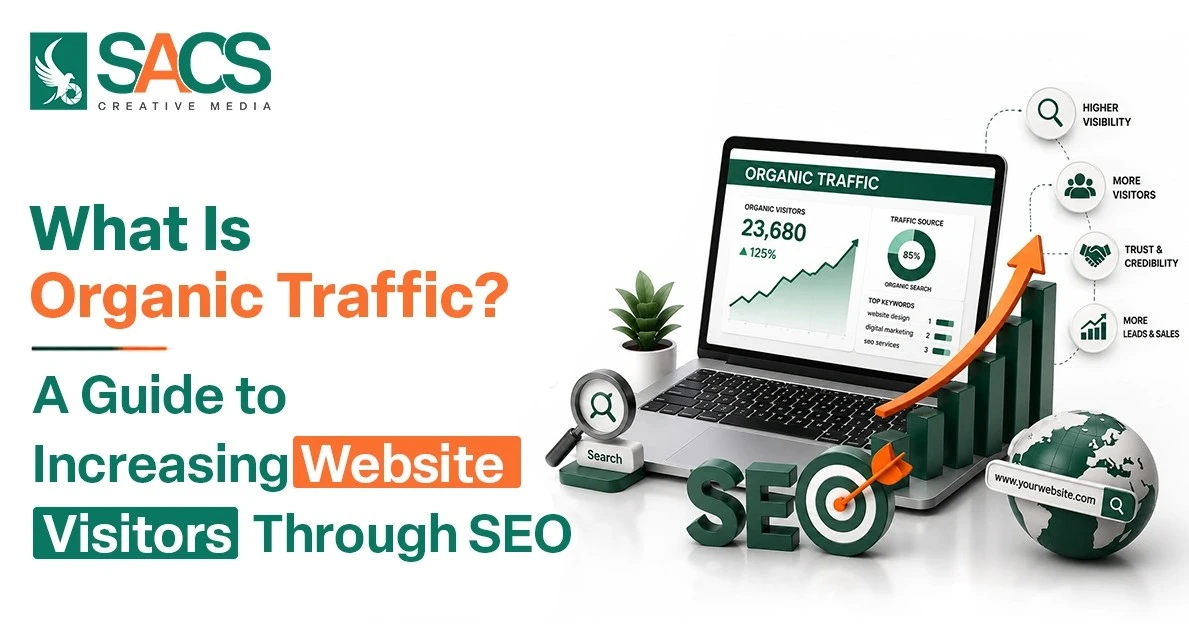
Organic Traffic is one of the most valuable ways to attract potential customers to your website without paying for every click. It refers to visitors who find your website through unpaid search engine results after searching for information, products, services, or solutions related to your business.
Unlike paid advertising, you do not pay for each organic visit. Instead, your website earns visibility through relevant content, SEO, website authority, technical performance, and a positive user experience. In this guide, we will explain how organic search works, why it matters, and practical SEO strategies you can use to attract more relevant visitors and turn website traffic into real business opportunities.
What Is Organic Traffic?
Organic Traffic is the number of visitors who reach your website through unpaid search engine results. When someone searches for a product, service, question, or solution on Google or another search engine and clicks your website from the natural search results, that visit is counted as organic.
For example, imagine a business owner searches for “website design company in Dubai.” If your website appears in the search results and the person clicks on your page without seeing or clicking a paid advertisement, that visit comes from organic search.
This type of traffic is different from paid search traffic, social media traffic, referral traffic, or direct traffic. The main difference is how the visitor discovers your website. With paid search, you pay for advertising visibility. With organic search, your website earns visibility by demonstrating relevance, usefulness, authority, and a good experience for users.
How Does Organic Search Work?
Search engines aim to provide users with the most useful and relevant answers to their searches. To do this, they discover, analyse, and organise billions of web pages before deciding which pages should appear for particular queries.
The process can be broadly understood through three important stages: crawling, indexing, and ranking.
Crawling
Search engines use automated programs, commonly known as crawlers or search engine bots, to discover web pages. These bots follow links and revisit existing pages to understand new or updated information.
If important pages on your website cannot be crawled properly, search engines may have difficulty discovering or understanding them. This is why technical SEO is an important part of building search visibility.
Indexing
After a page is discovered, search engines analyse its content and decide whether it should be included in their index. Being indexed means that the page is stored and can potentially appear when someone performs a relevant search.
A page should provide useful information, have a clear purpose, and be technically accessible if it is expected to perform well in search results.
Ranking
When someone enters a search query, the search engine evaluates relevant pages and determines which results are most appropriate. Many factors can influence rankings, including relevance, content quality, website authority, technical performance, user experience, and the context of the search.
When a user selects your unpaid search result, the resulting visit becomes organic search traffic.
Why Is Organic Traffic Important for Businesses?
Organic Traffic can be valuable because it often reaches people who are already searching for something related to your business. Instead of interrupting someone with an advertisement, search allows your website to appear when a person has an existing question, problem, or purchasing need.
For example, someone searching for “event photography services in Dubai” is likely to have a different level of intent from someone casually viewing photography content on social media. The searcher has already identified a requirement and may be actively comparing available options.
This makes search visibility particularly useful for service providers, ecommerce businesses, local companies, B2B organisations, professional services, and businesses targeting customers in specific locations.
Another advantage is that a well-optimised page can continue attracting visitors long after it has been published. While SEO requires ongoing maintenance and improvement, successful pages can provide value over a much longer period than a short advertising campaign.
SEO and Organic Traffic: What Is the Connection?
SEO, or Search Engine Optimisation, is the process of improving a website so that search engines can better understand its content while users can easily find, navigate, and use it.
The goal of SEO should not simply be to rank for hundreds of keywords. A stronger approach is to attract people who are genuinely interested in what your business provides.
A complete SEO strategy can include keyword research, search intent analysis, helpful content creation, on-page optimisation, technical SEO, internal linking, local SEO, digital PR, link building, mobile optimisation, page speed improvements, and conversion optimisation.
When these activities work together, they can help a website improve its visibility and attract more relevant visitors from search engines.
7 Practical Ways to Increase Website Visitors Through SEO
1. Understand What Your Audience Is Searching For
Before choosing keywords, understand your audience. Think about the questions customers ask before contacting your business, the problems they are trying to solve, and the information they need before making a decision.
For example, a web design company may find that potential customers search for questions such as:
- How much does a business website cost?
- What should a company website include?
- How long does website development take?
- Which platform is best for an ecommerce website?
- How can I improve my website conversion rate?
These searches represent different stages of the customer journey. Some users are researching, some are comparing options, and others are ready to contact a service provider.
Understanding this difference allows you to create content that addresses users at the right stage instead of producing articles simply because a keyword has search volume.
2. Match Your Content With Search Intent
Search intent is the reason behind a person’s search. Understanding it can make a major difference to your SEO performance.
Someone searching for “what is SEO” is probably looking for educational information. Someone searching for “SEO agency in Dubai” may be comparing service providers. A person searching for a specific company name may already know which business they want to visit.
Your content should match that intent. If a user wants a simple explanation, give them a clear answer. If they are comparing services, provide useful information that helps them make an informed decision.
When content satisfies the reason behind the search, visitors are more likely to stay on the page, explore other sections of your website, and take the next step.
3. Create Helpful and Original Content
Organic Traffic does not increase simply because a website publishes a large number of articles. Quality, relevance, and usefulness are much more important than publishing content for the sake of quantity.
Before creating a new page or blog post, ask yourself: What will the reader learn, understand, or achieve after reading this?
Strong content should answer real questions, explain complicated topics in simple language, provide practical examples, and avoid unnecessary repetition. It should also offer information that is genuinely useful rather than rewriting the same points found across dozens of competing pages.
Businesses can make their content more valuable by adding original examples, expert insights, comparisons, data, practical recommendations, and information relevant to their target market.
4. Optimise Important On-Page Elements
Search engines need clear signals to understand what a page is about. On-page optimisation helps communicate the purpose and relevance of your content.
Important elements include page titles, headings, URLs, meta descriptions, image alt text, internal links, relevant keywords, and supporting terminology.
Keywords should be used naturally rather than repeated in every paragraph. Search engines can understand context and related concepts, so good writing should always come before keyword repetition.
A well-optimised page should make sense to a human visitor first. The structure should be clear, headings should guide the reader, and the content should answer the questions that brought the visitor to the page.
5. Strengthen Internal Linking
Internal links connect one page of your website to another. They help visitors discover related information and help search engines understand the relationship between different pages.
For example, an article about search engine traffic could naturally link to related resources about keyword research, technical SEO, local SEO, content marketing, or website optimisation.
A thoughtful internal linking structure can improve navigation, support important service pages, help search engines discover content, and create a smoother user journey.
The key is relevance. Every internal link should provide additional value to the reader rather than being added simply to increase the number of links on a page.
6. Improve Technical SEO
Even excellent content may struggle to perform if a website has technical problems. Technical SEO focuses on the foundations that allow search engines to crawl, understand, and access your website efficiently.
Businesses should regularly review mobile responsiveness, page speed, broken links, indexing issues, XML sitemaps, robots.txt, HTTPS security, duplicate content, canonical tags, redirects, Core Web Vitals, and structured data where appropriate.
Technical SEO becomes particularly important for large websites with hundreds or thousands of pages. Fixing technical issues can help search engines access important content while also improving the experience for visitors.
7. Build Website Authority
Organic Traffic can become more sustainable when a website builds authority within its industry. Search engines use various signals to understand whether a website is trustworthy and relevant to a particular topic.
Relevant backlinks from credible websites can contribute to this authority. Potential opportunities may include industry publications, local media, business associations, professional communities, partnerships, expert contributions, digital PR, and useful online resources.
Businesses can also use Social Bookmarking Sites and Business Listing Sites as part of a broader online visibility strategy. However, these activities should support a wider SEO plan rather than replace quality content, technical optimisation, or authoritative link building.
The objective should always be to build a trustworthy online presence instead of simply collecting large numbers of links or listings.
How Local SEO Can Increase Website Visitors
For businesses serving specific cities or regions, local SEO can be particularly valuable. Customers often search for services together with a location, such as “photography services in Dubai,” “web design company in Sharjah,” or “SEO agency near me.”
These searches show that the user is looking for a business that can serve a particular location. Optimising for local search can therefore help businesses connect with people who are more likely to become customers.
Local SEO activities can include optimising your Google Business Profile, creating useful location pages, maintaining accurate business information, publishing locally relevant content, earning local citations, collecting genuine customer reviews, and building relationships with relevant local websites.
For UAE businesses, local relevance can be especially important when targeting customers in Dubai, Abu Dhabi, Sharjah, Ajman, Fujairah, and other areas.
How to Measure Organic Search Performance
Improving Organic Traffic should not be based on assumptions. Businesses need to monitor performance and understand whether their SEO efforts are generating meaningful results.
Google Analytics can help businesses understand website visitors, engagement, conversions, and user behaviour. Google Search Console can provide information about search queries, impressions, clicks, average position, click-through rate, indexing, and search-related issues.
However, traffic should not be the only measurement. A website receiving thousands of visitors but generating no enquiries may not be performing as well as a smaller website attracting highly relevant visitors who become customers.
Important business metrics can include contact form submissions, phone calls, WhatsApp enquiries, quote requests, product purchases, consultation bookings, and other meaningful conversions.
The purpose of SEO is not simply to generate more visitors. It is to attract the right visitors and help turn their interest into measurable business results.
How Long Does It Take to See Results From SEO?
SEO is a long-term marketing activity, so businesses should not expect significant results overnight. The timeline can depend on the website’s existing authority, competition, technical condition, content quality, backlink profile, target keywords, industry, and consistency of optimisation.
A new website may require more time to establish credibility, while an established website with strong authority may see improvements sooner after important content or technical issues are corrected.
Instead of focusing only on immediate rankings, businesses should think about Benefits of SEO as a progression: foundation, visibility, rankings, qualified visitors, leads, and growth.
Some pages may improve relatively quickly, while highly competitive search terms can take considerably longer. Search results also change as competitors publish new content, user behaviour evolves, and search engines update their systems.
Common SEO Mistakes That Can Limit Website Growth
Focusing Only on High-Volume Keywords
A keyword with thousands of monthly searches is not automatically the best choice for your business. A lower-volume keyword with strong commercial intent may produce more valuable leads.
Writing for Search Engines Instead of People
Content filled with repetitive keywords, awkward sentences, and unnecessary sections can create a poor user experience. SEO should support good content rather than control how every sentence is written.
Ignoring Existing Content
Sometimes the best opportunity is not creating another blog post. Updating an older page can produce better results.
Review existing content for outdated information, broken links, missing sections, weak examples, poor formatting, and changes in search intent. Refreshing useful content can help keep your website relevant.
Neglecting Mobile Users
A significant number of searches take place on mobile devices. If your website is difficult to read, navigate, or interact with on a smartphone, visitors may leave before taking any action.
Measuring Only Rankings
Search rankings are useful indicators, but they are not the final business goal. Qualified visitors, engagement, enquiries, conversions, and revenue provide a much clearer picture of whether SEO is working.
Should You Handle SEO Yourself or Hire a Professional?
Small businesses can manage some SEO activities internally, especially basic content creation, website updates, and local optimisation. However, as competition increases, SEO becomes more complex and requires consistent effort.
Technical SEO, competitive keyword research, content strategy, analytics, link building, conversion optimisation, and ongoing monitoring all require time and experience. If your team does not have the resources to manage these areas consistently, working with a professional agency can be a practical option.
Businesses looking for a Best SEO Service in UAE should evaluate providers based on their strategy, transparency, experience, communication, reporting, and understanding of the client’s industry rather than choosing a company simply because it promises fast rankings. SACS Creative Media helps businesses build a stronger online presence through practical, search-focused strategies designed around their business goals and target audience.
A good SEO partner should clearly explain what will be done, why it matters, how progress will be measured, and what realistic outcomes can be expected. The right approach is not about promising instant rankings but about building sustainable search visibility that can support long-term business growth.
The Long-Term Value of Search Visibility
When a website successfully attracts Organic Traffic, the value can extend beyond individual website visits. A useful article may continue attracting visitors months after publication, while a well-optimised service page can continue generating enquiries over time.
This does not mean SEO becomes completely passive after a page starts ranking. Competitors continue creating content, search behaviour changes, websites become outdated, and search engine algorithms continue evolving.
For this reason, businesses should treat SEO as an ongoing process. Regular content updates, technical checks, competitor research, performance analysis, and optimisation help maintain search visibility and keep the website aligned with customer needs.
Conlusion
Organic Traffic is ultimately about helping the right people discover your website when they are actively searching for information, products, or services that your business can provide.
The strongest approach combines useful content, search intent, keyword research, technical SEO, internal linking, local relevance, website authority, and a positive user experience. Simply publishing more content or repeating keywords will not create sustainable results.
Instead, focus on creating a website that answers genuine customer questions, demonstrates expertise, loads efficiently, works well on mobile devices, and provides a clear path toward taking action.
When these elements work together, search visibility becomes more than an SEO metric. It can become a reliable part of your digital marketing strategy, helping your business attract relevant visitors, generate enquiries, and build long-term online growth.
The goal is simple: help the right people find your website, give them a reason to stay, and make it easy for them to take the next step.