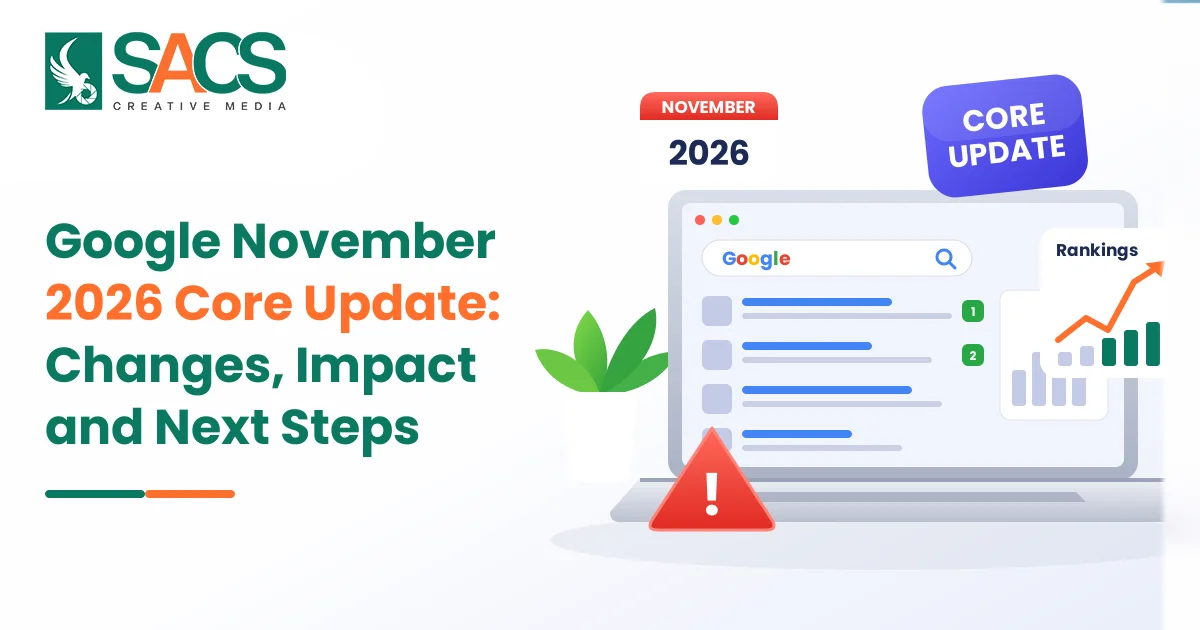
The Google November 2026 Core Update is a broad change to Google’s search ranking systems. The rollout started on November 10, 2026, and is expected to take up to two weeks to complete. Applying globally across all languages, it is the third confirmed core update of 2026, following the March and May updates.
As the rollout continues, websites may experience changes in keyword rankings, search visibility and organic traffic. Businesses should monitor their website performance and understand how the update affects their important pages before making SEO changes.
What Is the Google November 2026 Core Update?
Google regularly updates its search ranking systems to improve the quality of results shown to users. A core update involves broader changes to these systems, helping Google identify and present pages that better satisfy search queries.
Unlike a spam update, a core update does not necessarily target websites that violate Google’s guidelines. Instead, it can change how Google evaluates and compares content across different websites.
Google announced the November update on November 10, 2026, through its Search Status Dashboard. According to the announcement, the update:
- Applies globally across all countries and regions.
- Covers all languages.
- May take up to two weeks to complete.
- Focuses on improving the relevance and satisfaction of search results.
Google also described it as a regular update designed to better surface relevant, satisfying content from websites of all types.
As of November 16, the rollout remains active. This means the ranking results may continue changing until Google confirms completion.
What Has Changed in the November 2026 Update?
Google has not released a detailed breakdown of the changes introduced in this update. Therefore, it would be inaccurate to claim that a particular content format, website category or ranking factor has been specifically targeted.
However, Google’s announcement provides an important direction: its ranking systems are being updated to identify content that better meets users’ needs.
Here are some areas website owners should pay attention to.
1. More Focus on Relevant and Helpful Content
Content relevance remains important for appearing in search results. A page should directly address the topic users are searching for instead of including unnecessary information to increase its word count.
For example, someone searching for a website design company in Dubai may want to understand available services, design approaches, development processes and business benefits.
A page that answers these questions clearly is more useful than one filled with repeated keywords and general marketing statements.
Businesses should review their existing content and check whether it provides practical information, answers customer questions and offers something valuable beyond what is already available online.
2. Content Quality and Search Intent
Matching search intent is essential for creating content that satisfies users.
Google aims to show results that fulfil the purpose behind a search query. A person looking for information expects an informative article, while someone searching for a service may want pricing details, service descriptions, examples or a way to contact a provider.
If a page does not match what visitors expect, it may struggle to perform well even when it includes relevant keywords.
Review your important landing pages and blog posts to ensure that the content matches the search intent behind their target queries.
3. Website Experience and Usability
A good website experience helps visitors access information without unnecessary difficulty. Navigation, mobile responsiveness, readable content and page loading performance all contribute to how people interact with a website.
A business website should make it easy for visitors to understand its services, explore important pages and take action.
Although Google has not announced any specific changes to usability signals in this update, maintaining a technically sound and user-friendly website remains an important part of an effective SEO strategy.
4. Original Information and Demonstrated Experience
Publishing content that simply repeats information available on other websites offers limited value to readers.
Businesses should share original insights, practical examples, industry knowledge and genuine experience wherever possible.
For example, a digital marketing agency can explain common SEO challenges it encounters, discuss practical approaches to improving website visibility and provide useful recommendations based on its professional experience.
This makes content more informative and helps establish credibility with potential customers.
How Will the Update Affect Website Rankings?
The Google November 2026 Core Update may affect website rankings differently depending on the quality, relevance and usefulness of individual pages.
Some websites may experience improved visibility, while others may notice ranking declines or changes in search impressions.
There is no single impact that applies to every website.
Here are some possible outcomes businesses should understand.
Improved keyword rankings: Pages that become more relevant to particular searches may gain better positions in Google results.
Ranking fluctuations: Some keywords may move up or down while Google’s systems continue adjusting during the rollout.
Changes in search visibility: Websites may receive more or fewer impressions depending on how their pages perform against competing results.
Traffic variations: Ranking changes can influence the number of visitors reaching a website through search.
Different page-level performance: Some pages may improve while other pages on the same website experience a decline.
It is important to remember that a ranking drop does not automatically mean Google has penalised a website. Core updates involve changes to how Google assesses content across the web. A competitor’s page may become more relevant to a particular search, even when your own page has not changed.
What Should Website Owners Do After the Update?
The best approach is to understand performance changes before making major website modifications.
Google recommends waiting until a core update is complete and then allowing at least one full week before analysing the results. This helps website owners avoid making decisions based on temporary ranking movements.
The following steps can help businesses review their websites and identify areas that need attention.
1. Monitor Google Search Console Performance
Google Search Console is one of the most useful tools for understanding how your website performs in organic search.
Check the following metrics:
- Clicks: Find out whether the number of visitors coming from Google has increased or decreased.
- Impressions: Check whether your pages are appearing more or less frequently in search results.
- Average position: Identify keywords and pages that have experienced ranking changes.
- Click-through rate (CTR): Understand whether users are clicking your website when it appears in search results.
Compare performance after the update with the week before it started on November 10.
For a more reliable assessment, follow Google’s recommendation to wait until the rollout finishes and then allow another full week before making comparisons.
Also, avoid comparing periods with very different seasonal demand. For example, an ecommerce website may experience traffic changes because of Black Friday promotions rather than the algorithm update alone.
2. Review Pages That Have Lost Rankings
If some pages experience a noticeable decline, investigate them individually.
Start by identifying which keywords and search queries have lost visibility. Then examine the pages that previously ranked well.
Ask these questions:
- Does the content answer the main search query?
- Is the information accurate and updated?
- Does the page provide enough useful detail?
- Are there better resources available from competing websites?
- Is the page easy to navigate on mobile devices?
- Does the content demonstrate genuine knowledge of the subject?
Avoid rewriting every page immediately. Identify specific weaknesses and make improvements where they can provide genuine value.
3. Improve Existing Content Instead of Publishing More
Publishing more articles does not automatically improve website rankings.
Businesses should first review their existing content and identify opportunities to make it more useful.
For example, you can:
- Update outdated statistics and information.
- Add relevant examples and practical explanations.
- Remove repetitive or unnecessary paragraphs.
- Improve headings to make information easier to scan.
- Answer common customer questions directly.
- Replace unsupported claims with accurate information.
Content improvements should focus on helping readers understand the subject, not simply increasing the article length.
4. Strengthen Your Website’s Technical Foundation
A website must be accessible to search engines and provide a smooth experience for visitors.
Review important areas of Technical SEO, including crawlability, indexing, internal linking, broken pages, page speed, mobile responsiveness and structured data.
Check whether important pages return the correct HTTP status codes and whether Google can access the content without technical restrictions.
Also review Core Web Vitals and make sure important website elements load and respond properly.
Technical improvements cannot guarantee ranking recovery, but they can help prevent avoidable website issues from affecting search visibility.
5. Improve Internal Linking
Internal links help users and search engines discover related information across your website.
For example, a blog discussing Google’s ranking updates can naturally link to relevant articles about SEO strategies, content optimisation, website performance and search visibility.
Use descriptive anchor text that explains what visitors can expect from the linked page.
Avoid adding links only to increase their number. Every internal link should have a clear purpose and help readers explore relevant information.
6. Focus on Real Business Value
A website should do more than attract visitors. It should help people find information, understand your services and make informed decisions.
Review whether your service pages explain what your business offers, who can benefit from your services and how customers can get started.
Include genuine project examples, customer testimonials where available, clear service descriptions and useful contact information.
A website that provides a good experience and builds customer confidence supports long-term business growth.
How Can Businesses Prepare for Future Google Updates?
Google continuously improves its search systems, so businesses should not depend on a single ranking strategy.
A sustainable approach focuses on building a useful website, maintaining accurate information and understanding what customers need.
Here are some practices worth following.
Publish people-first content: Create articles and service pages that answer real questions and provide practical information.
Build topical authority: Cover important subjects related to your industry in sufficient depth. Link related articles and service pages naturally to create a useful content structure.
Keep information updated: Review important pages regularly, especially when services, industry developments or customer expectations change.
Strengthen website credibility: Provide clear business information, author details where relevant, genuine experience and reliable references.
Improve mobile usability: Make sure visitors can read content, navigate pages and contact your business easily on mobile devices.
Measure meaningful results: Monitor search performance, enquiries, conversions and user engagement instead of focusing only on keyword positions.
Search behaviour is also changing with AI-powered search experiences. Businesses should structure their content clearly so search engines and AI systems can understand the information. Topics such as Google AI Overviews make it increasingly important to provide direct answers, useful explanations and trustworthy information.
However, there is no guaranteed method of securing a place in AI-generated answers. Strong content quality, relevance and a technically accessible website provide a sensible foundation.
Common Mistakes to Avoid During a Core Update
When rankings change, some website owners make immediate modifications without understanding the actual reason behind the decline.
This can create additional problems instead of improving performance.
Avoid these common mistakes:
- Changing everything at once: Large-scale website modifications make it difficult to identify which changes affected performance.
- Deleting pages unnecessarily: A ranking decline alone is not a reason to remove existing content.
- Overusing keywords: Repeating keywords unnaturally does not make content more useful or relevant.
- Publishing content in bulk: Increasing article volume without maintaining quality can reduce overall content value.
- Ignoring search intent: Content should answer what users actually want to know.
- Chasing temporary ranking changes: Rankings can fluctuate during the rollout, so avoid reacting to every movement.
A careful review and a clear improvement plan are more effective than making rushed SEO decisions.
Concusion
The Google November 2026 Core Update reinforces Google’s ongoing focus on delivering relevant and satisfying search results. Although the company has not disclosed specific ranking changes, website owners should use this update as an opportunity to review content quality, website usability and overall search performance.
Do not assume that every ranking decline requires an immediate technical fix or a complete content rewrite. Monitor Google Search Console, wait for the rollout to finish and identify the pages that genuinely need improvement.
For businesses, maintaining a useful website and providing reliable information should remain the priority. Consistent SEO improvements, original content and a positive user experience can help build stronger search visibility over time.
At SACS Creative Media, a trusted SEO Company in Dubai, we help businesses improve their online presence through professional SEO strategies, website optimisation and digital marketing services. If your website has experienced ranking fluctuations or you want to strengthen its search performance, our team can identify improvement opportunities and develop an SEO strategy that supports your business goals.