SACS Creative Media offers professional Ecommerce Website Development in Dubai, helping businesses build high-performing online stores that are easy to navigate, visually engaging, secure, SEO-friendly, and designed to turn visitors into customers. Whether you are launching a new ecommerce brand or upgrading an existing store, the right website can make it easier for customers to discover your products, trust your brand, and complete purchases with confidence.
If you are wondering whether investing in professional ecommerce development is worth it, consider what your online store needs to achieve. Beyond displaying products, it should provide a smooth shopping experience, work seamlessly across mobile devices, support secure payments, load quickly, and make it simple for customers to find what they need. Professional web design in Dubai can also contribute to a consistent brand experience by combining appealing visuals with intuitive layouts and user-focused navigation.
A well-built ecommerce website can also support your wider digital marketing efforts. A search-friendly structure can help search engines understand your products and pages, while clear calls to action, optimized product descriptions, fast loading times, and a streamlined checkout process can encourage more visitors to take action.
So, what makes professional ecommerce website development a worthwhile investment for a Dubai business? From improving customer experience and strengthening online visibility to creating a scalable platform for future growth, the right ecommerce solution can have a direct impact on your digital performance. Below, we explore seven powerful reasons to invest in professional ecommerce website development in Dubai.
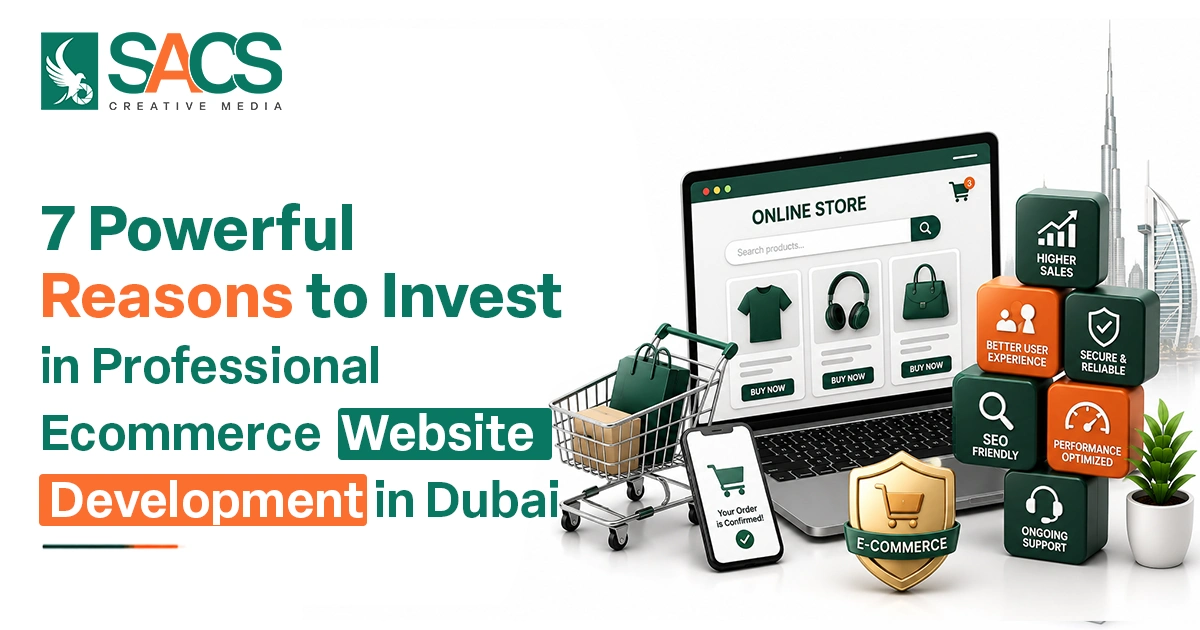
Here are the 7 Powerful Reasons to Invest in Professional Ecommerce Website Development in Dubai
An ecommerce website is often the first place where a customer meets your brand. A slow store, confusing navigation, weak product pages, or difficult checkout can quickly send a buyer to a competitor. Professional development focuses on building a store that works for both people and search engines.
1. Build a Store That Matches Dubai’s Competitive Market
Dubai has a diverse customer base made up of local residents, expatriates, tourists, and international buyers. This means an online store needs to communicate clearly with different audiences while keeping the brand identity consistent.
Professional Ecommerce Website Development in Dubai helps businesses create a store around their actual audience instead of using a generic template without a clear purpose. Developers can structure categories, product pages, filters, checkout steps, and calls to action based on how customers are likely to shop.
For example, a fashion store may need strong product photography, size information, filters, and quick checkout. A furniture business may need product dimensions, delivery details, material information, and inquiry options. A B2B supplier may need bulk pricing, quotation requests, and account-based purchasing. This approach makes the website more useful because every important element has a reason to exist.
A professional ecommerce store can also support local buying habits by making delivery areas, payment methods, return policies, and contact options easy to find. When customers do not have to search for basic information, they can make decisions with greater confidence.
2. Create Better User Experiences That Increase Conversions
Getting visitors to an ecommerce website is only one part of digital marketing. The bigger question is what happens after they arrive.
A professional store should guide users from the landing page to product discovery, product evaluation, cart, and checkout without unnecessary friction. Clear menus, useful filters, readable product descriptions, visible pricing, strong calls to action, and a simple checkout process can make the buying journey easier.
Professional Ecommerce Website Development in Dubai can also focus on mobile-first experiences. Many customers browse products from smartphones, so buttons must be easy to tap, images should load correctly, forms should be simple, and important information should not be hidden behind confusing layouts. A good user experience is not about adding more features. It is about removing obstacles.
For example, if customers frequently ask about delivery time, that information should be visible on the product or checkout page. If shoppers need to compare products, comparison tools or clear specifications can help. If users abandon carts because checkout feels complicated, reducing unnecessary fields may improve completion rates. SACS Creative Media can use this conversion-focused thinking when planning ecommerce experiences for businesses that want their websites to support real business goals.
3. Strengthen SEO From the Technical Foundation
Search visibility starts with the website structure. Adding keywords to a few pages is not enough to build sustainable organic traffic.
Professional development can create a logical architecture where search engines can understand categories, products, brands, and supporting content. Clean URLs, crawlable navigation, proper heading structures, descriptive image alt text, canonical tags, XML sitemaps, structured data, and strong internal linking can all support technical SEO.
Page speed is another important consideration. Large product images, unnecessary scripts, poor hosting, and excessive plugins can make an online store slow. Developers can improve performance by optimizing images, reducing unnecessary code, using caching, and selecting suitable hosting infrastructure.
An ecommerce site should also have indexable product and category pages without creating thousands of duplicate or low-value URLs. Filters and sorting options need careful technical handling so that they do not create unnecessary crawl problems.
This is where a professional approach becomes valuable. SEO is considered during development rather than being added after the website is finished. The goal is not simply to rank one page. The goal is to build a website that gives search engines a clear understanding of the entire business.
4. Make Product Pages More Helpful for Customers and Search Engines
Product pages are where many ecommerce decisions happen. A strong product page should answer the questions a buyer is likely to have before clicking the purchase button.
Useful product pages normally include a clear product name, concise description, detailed specifications, pricing, availability, delivery information, high-quality images, FAQs where relevant, reviews, and a clear call to action.
This supports AEO, or Answer Engine Optimization, because users increasingly search for direct answers such as “What is the best material for outdoor furniture?” or “How long does delivery take in Dubai?” Businesses can address these questions through product content, FAQs, buying guides, and helpful category pages.
The same content can also support GEO, or Generative Engine Optimization. AI-powered search experiences often look for clear, trustworthy, well-structured information that directly answers a user’s question. Product information should therefore be factual, easy to understand, and consistent across the website.
For ecommerce brands, this means content should not be written only for algorithms. It should help a real customer understand the product. A useful strategy is to identify common customer questions before writing product descriptions. Sales teams, customer support conversations, reviews, and search queries can reveal what buyers actually want to know.
5. Use Data, Analytics, and Personalization to Improve Sales
A professional ecommerce website should not be treated as a finished project after launch. It should become a source of useful business data. Analytics can show which products receive the most attention, where visitors leave the website, which devices generate purchases, which landing pages perform well, and where customers abandon their carts. These insights help businesses make informed improvements.
For example, if many users view a product but few add it to the cart, the problem may be pricing, product information, trust signals, images, or the call to action. If users add products to the cart but leave before payment, the checkout process, delivery charges, or payment options may need review.
Professional Ecommerce Website Development in Dubai can also make it easier to connect ecommerce platforms with analytics, CRM systems, email marketing tools, inventory systems, payment gateways, and other business software.
Personalization can add another layer. Businesses may recommend related products, show recently viewed items, create customer-specific offers, or build loyalty experiences based on shopping behavior. The key is to use data responsibly and focus on improvements that make shopping easier.
6. Build a Secure and Scalable Ecommerce Platform
Customers need to trust an ecommerce website before they are comfortable sharing personal and payment information. Security should therefore be part of the development process from the beginning.
Professional development can include secure hosting, SSL protection, regular updates, strong authentication, safe payment integrations, access controls, backups, and monitoring. Payment information should be handled through trusted payment providers rather than stored unnecessarily on the website.
Scalability is equally important. A small store may begin with a few dozen products and later grow to hundreds or thousands. Traffic can also increase during seasonal campaigns, product launches, promotions, and special events. A website that works under normal traffic may struggle when demand suddenly increases.
A scalable technical structure helps businesses grow without rebuilding the entire website every time they add products or customers. Businesses should also think about integrations early. Inventory management, shipping platforms, accounting tools, customer relationship systems, marketplaces, and marketing platforms may become important as the company grows.
Professional Ecommerce Website Development in Dubai gives businesses a foundation that can adapt as their operations become more complex.
7. Stay Competitive With Modern Ecommerce Design and Technology
Customer expectations change quickly. A website that looked modern a few years ago may feel outdated today. Businesses should regularly review their design, navigation, mobile experience, checkout process, content, and technology. The goal is not to follow every trend blindly but to adopt improvements that make the customer journey better.
When reviewing eCommerce Website Design Strategies, businesses should focus on practical areas such as mobile usability, product discovery, visual hierarchy, trust signals, accessibility, page speed, and frictionless checkout.
Keeping an eye on eCommerce Web Design Trends can also help businesses understand how customer expectations are changing. However, trends should support the brand rather than overpower it. A clean interface that helps customers buy confidently is more valuable than a visually impressive design that makes shopping difficult.
SACS Creative Media can help businesses combine design, development, content, and digital marketing into one ecommerce strategy. This creates a stronger connection between the website and broader marketing activities.
What Should a Professional Ecommerce Website Include?
A modern ecommerce store may include many features, but the right features depend on the business model. Some common essentials include:
- Mobile-responsive design
- Easy product search and filtering
- Well-structured categories
- High-quality product images
- Detailed product information
- Customer reviews
- Secure payment options
- Multiple delivery choices
- Clear return and refund information
- Wishlist or saved products
- Cart recovery options
- Analytics and conversion tracking
- Social media integration
- SEO-friendly architecture
- Fast-loading pages
- Customer support options
The important point is that features should solve customer problems. Adding a feature simply because another ecommerce store has it can make the website more complicated without improving results.
How Ecommerce Development Supports SEO, AEO, and GEO
A strong ecommerce strategy connects three important search approaches.
SEO helps a website become visible in traditional search results. This includes technical performance, keyword targeting, content quality, internal linking, site structure, and authority.
AEO focuses on providing direct answers to user questions. Ecommerce brands can support this through FAQs, buying guides, product comparisons, category explanations, and clear product information.
GEO focuses on making content useful and understandable for AI-driven search experiences. Clear entities, consistent facts, concise answers, strong topical coverage, and trustworthy information can help AI systems better understand what a business offers.
These approaches should not be treated as three separate content strategies. They can work together.
For example, a category page can target a commercial search query, explain the category clearly, answer common buyer questions, link to relevant products, and provide structured information. One useful page can therefore support organic search, answer-focused search, and AI-generated search experiences at the same time.
Why Local Ecommerce Expertise Matters in Dubai
Dubai has its own commercial environment, customer expectations, delivery patterns, payment preferences, and competitive landscape. A website created without understanding the local market may miss important opportunities.
A locally focused strategy can consider factors such as AED pricing, delivery locations, customer support availability, Arabic and English content where appropriate, local search behavior, seasonal promotions, and the expectations of customers shopping in the UAE.
For this reason, choosing a team with experience in the local digital market can make the development process more practical. The best approach is to start with business goals. Decide what the website needs to achieve, who the customers are, what products are most important, and which actions should count as conversions. The design and technology can then be selected around those objectives.
For businesses that want Ecommerce Website Development in Dubai, local market knowledge can make the difference between a website that simply exists and one that actively supports sales.
How to Choose the Right Ecommerce Development Partner
Before selecting a development company, ask a few practical questions. Does the team understand ecommerce UX? Can they explain how the website will be optimized for search engines? Do they have a clear approach to mobile performance? Can they integrate payment, delivery, analytics, and inventory systems? Will they provide maintenance after launch?
It is also useful to review previous ecommerce projects and look beyond visual design. Check whether the websites are easy to navigate, fast on mobile devices, technically sound, and clear about products and purchasing. A good development partner should also explain technical decisions in simple language. You should understand what is being built, why it is needed, and how it supports your business.
SACS Creative Media takes this broader approach by connecting website design, development, content, SEO, and digital marketing around business objectives rather than treating the website as an isolated project.
Conclusion
Investing in a professional ecommerce store is an investment in the way your business sells online. The website needs to do more than display products. It should build trust, answer questions, simplify purchasing, support marketing, and provide a strong technical foundation for future growth.
For businesses competing in Dubai, Ecommerce Website Development in Dubai can be a valuable step toward creating a stronger digital sales channel. The right approach combines user experience, technical SEO, useful content, security, analytics, scalability, and local market understanding.
If your goal is long-term online growth, focus on building a store that customers genuinely find useful. A fast, clear, secure, and helpful ecommerce website can support both immediate conversions and sustainable visibility.
With the right strategy and development partner, your ecommerce website can become more than an online catalogue. It can become a dependable part of your sales and marketing system.