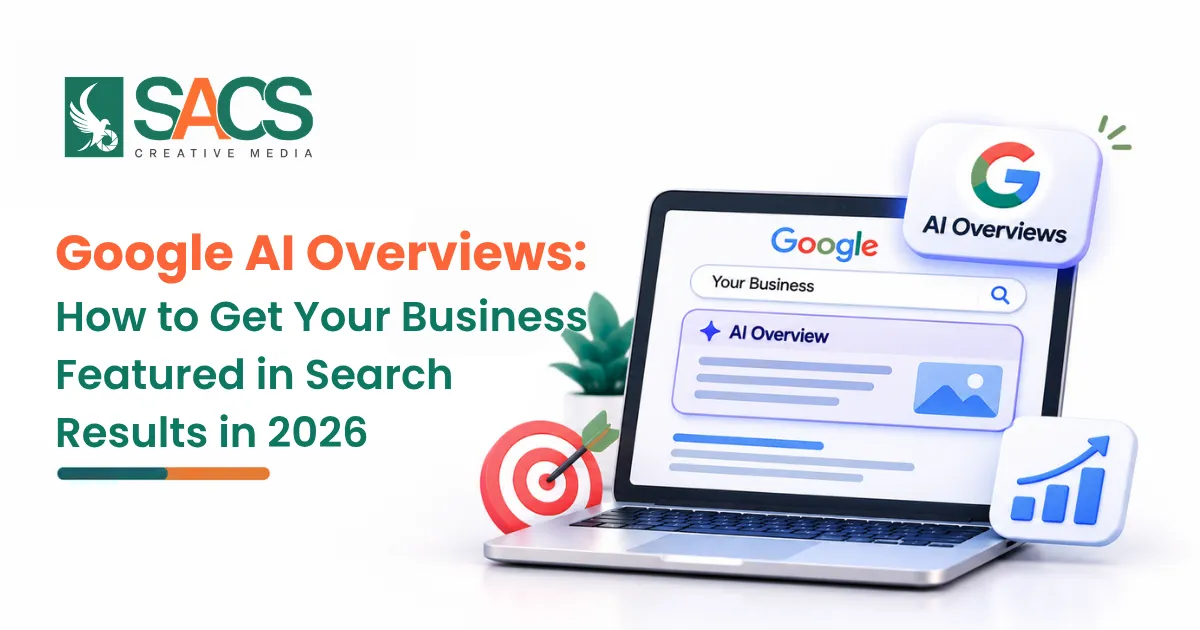
Google AI Overviews select and present relevant information from websites to answer users’ search queries directly within Google Search. Businesses can improve their chances of being included by publishing accurate, original and well-structured content, maintaining strong technical SEO and demonstrating genuine knowledge of their industry.
For businesses, this introduces another way to reach potential customers through organic search. Instead of relying entirely on traditional search rankings, websites can also gain visibility when Google references their content in AI-generated answers.
However, appearing as a source requires more than inserting keywords or publishing frequent blog posts. Google needs to understand your content, access your pages and identify information that is relevant to a user’s query. This makes content quality, website accessibility and established SEO practices essential.
What Are Google AI Overviews?
Google AI Overviews are AI-generated summaries displayed within Google Search to help users find answers to selected queries. They bring together relevant information from multiple sources and provide links to supporting webpages for users who want to explore a topic in greater detail.
For example, when someone searches for “How can a small business improve its online visibility?”, Google may generate a summary covering search engine optimisation, local SEO, website improvements and content marketing. The overview may also reference relevant websites that provide supporting information.
These search features create additional opportunities for websites to be discovered. A business may receive exposure through a supporting link even when its webpage is not displayed in the first traditional organic position. However, inclusion and placement depend on Google’s systems and the relevance of the content to each search query.
Why Does AI Search Visibility Matter for Businesses in 2026?
Search engines are changing how information is presented. Users can now find summaries, explanations and supporting sources directly on the search results page. For businesses, this means organic visibility involves more than competing for traditional keyword rankings.
Being referenced in an AI-generated answer can help introduce your brand to people researching products, services or solutions. The potential benefits include:
- Increased brand exposure: Your business can be discovered when Google references your website as a relevant information source.
- Qualified website traffic: Users who need further details may visit your website to explore your services, examples or recommendations.
- Brand recognition: Relevant mentions can help audiences become familiar with your business during their research.
- Early customer engagement: Informative content allows businesses to reach potential customers before they make purchasing decisions.
- Additional organic visibility: Your website has another opportunity to appear beyond conventional search listings.
Businesses should also understand that visibility does not automatically translate into website visits or sales. AI-generated summaries may answer a user’s question without requiring a click. Therefore, an effective search strategy should focus on meaningful brand exposure, relevant traffic and measurable business enquiries rather than visibility alone.
How to Get Your Business Featured in Google AI Overviews
There is no guaranteed method to get a website featured in an AI-generated answer. Google selects relevant information based on its search systems, content quality and the needs of individual queries.
However, the following SEO practices can improve your website’s eligibility and help Google understand the value of your content.
1. Create Content That Directly Answers Search Queries
One of the most effective ways to improve AI search visibility is to answer questions that your potential customers are already asking.
People often search using complete questions rather than short keywords. For example, instead of searching only for “website design”, a business owner might search for “How much does it cost to build a business website?”
Your content should address these questions without making readers go through several paragraphs to find the answer.
Consider these practices:
- Start each important section with a clear and direct answer.
- Use question-based headings where they fit naturally.
- Explain complicated topics using simple language.
- Include relevant examples to make information easier to understand.
- Use short paragraphs and bullet points for important details.
For example, if you publish an article about website speed, explain what website speed means, why it matters and how businesses can improve it. Covering the complete subject makes the page more useful than simply repeating a target keyword.
2. Follow Google’s Helpful Content and E-E-A-T Principles
Google wants to surface information that is helpful, reliable and created for people. This makes experience, expertise, authoritativeness and trust important considerations when developing website content.
E-E-A-T is particularly relevant when your content discusses subjects where readers need accurate and dependable information.
Businesses can strengthen these signals by:
- Publishing articles based on actual industry knowledge.
- Including practical examples from relevant projects and experience.
- Providing accurate company information and contact details.
- Adding author information where appropriate.
- Supporting factual statements with reliable sources.
- Updating outdated information when industry practices change.
For instance, a digital marketing agency can explain how it approaches keyword research, technical SEO and website optimisation. Sharing practical knowledge makes the content more valuable than publishing another general article about the benefits of SEO.
Remember, E-E-A-T is not a single ranking factor that guarantees visibility. It represents important quality considerations within Google’s broader approach to evaluating helpful content.
3. Organise Your Website Content with Clear Headings
A well-organised website makes information easier for visitors to understand and helps search engines interpret the main topics covered on each page.
Avoid placing every idea into long paragraphs. Divide your content into meaningful sections using descriptive H2 and H3 headings.
For example, an article about local SEO could include sections such as:
- What Is Local SEO?
- Why Is Local SEO Important for Small Businesses?
- How to Optimise Your Google Business Profile
- How to Improve Local Search Rankings
- Common Local SEO Mistakes to Avoid
Each heading should introduce a specific subject, followed by a clear explanation. Tables, numbered steps and bullet points can also help readers find important information quickly.
Good structure does not mean following a fixed content formula. Choose a format that makes the subject easier to understand.
4. Strengthen Your Website’s Technical SEO
Even excellent content may struggle to appear in search results if Google cannot access or index the page properly.
Technical SEO helps search engines discover, crawl and understand your website. It also provides a better experience for visitors.
Check the following technical elements:
- Indexing: Make sure important website pages are indexed by Google.
- Crawlability: Check that robots.txt and other website settings do not accidentally block important content.
- Mobile responsiveness: Ensure your website works properly across smartphones, tablets and desktops.
- Page speed: Optimise images, scripts and other elements that affect loading performance.
- Internal linking: Connect related pages to help visitors and search engines discover useful information.
- Canonical tags: Use appropriate canonical URLs to manage duplicate or similar pages.
- HTTPS: Protect website connections with a valid SSL certificate.
Google’s documentation confirms that pages must meet its normal Search technical requirements and be eligible to appear with a snippet to qualify for supporting links in AI search features.
Use Google Search Console to identify indexing problems, review website performance and monitor how Google discovers your content.
5. Build Topical Authority Around Your Main Services
Publishing one article about a subject is not always enough to demonstrate your website’s knowledge. Businesses should develop a collection of useful content around their main products, services and industry topics.
This approach is commonly known as building topical authority.
For example, a company offering digital marketing services can create related content covering:
- Search engine optimisation fundamentals.
- Technical SEO and website audits.
- Keyword research and search intent.
- Local SEO strategies.
- Content marketing and optimisation.
- Google Business Profile optimisation.
- SEO performance measurement.
These articles should be connected through relevant internal links. This helps visitors move between related topics while giving search engines a clearer understanding of your website’s subject areas.
Avoid creating multiple articles that repeat almost identical information just to target different keyword variations. Focus on covering genuinely useful topics instead.
6. Use Relevant Structured Data Correctly
Structured data helps search engines understand specific information about a webpage. Businesses commonly use schema markup to describe their organisation, services, articles, products and other relevant content.
Depending on your website, useful schema types may include:
- Organization: Provides information about your business.
- LocalBusiness: Describes relevant local business details.
- Article: Identifies important information about an article.
- Product: Describes product information for eligible pages.
- BreadcrumbList: Helps explain the structure of website navigation.
However, there is an important distinction. Google does not require special schema markup for inclusion in its AI-generated search features. Adding structured data does not guarantee an AI citation.
Use relevant schema that accurately represents the visible information on your website. You can test your markup using Google’s Rich Results Test and monitor technical issues through Search Console.
7. Publish Original Research, Examples and Useful Insights
Many websites publish similar articles covering the same topics. If your content only repeats commonly available information, it gives readers little reason to explore your website.
Original information can make your content more valuable and distinctive.
Consider including:
- Real examples from completed projects.
- Industry observations and practical recommendations.
- Original surveys or research findings.
- Comparisons based on clear evaluation criteria.
- Common mistakes your team has identified through experience.
- Relevant images, videos and demonstrations.
For example, instead of publishing a general article about website redesign, explain the problems businesses commonly experience with outdated websites and how specific design improvements can address them.
Original insights give your audience something useful that they may not find in every competing article.
8. Maintain Accurate Local Business Information
Local businesses should ensure that their online information is consistent and up to date. This is particularly important for companies targeting customers in specific cities or service areas.
Start by optimising your Google Business Profile with accurate information, including:
- Correct business name and category.
- Updated address and contact number.
- Accurate opening hours.
- Clear descriptions of your services.
- Relevant business photographs.
- Genuine customer reviews and responses.
Your website should also provide clear information about the locations you serve. Create useful location pages where they genuinely help customers instead of producing multiple pages with almost identical content.
For example, a business serving Dubai, Sharjah and Abu Dhabi can explain its services, availability and relevant local experience for each area.
Common Mistakes That Can Affect AI Search Visibility
Businesses sometimes focus so heavily on appearing in AI-generated results that they overlook the SEO practices that make a website useful and trustworthy.
Avoid these common mistakes:
- Publishing content without original value: Rewriting information already available on other websites does not make your article distinctive.
- Keyword stuffing: Repeating the same search phrase unnecessarily makes content difficult to read.
- Creating too many similar articles: Publishing multiple pages with overlapping information can weaken your overall content strategy.
- Ignoring technical issues: Crawlability, indexing and website accessibility still matter.
- Using misleading information: Unsupported statistics and exaggerated claims can damage content credibility.
- Overusing AI-generated content: Automatically publishing large amounts of unhelpful content can violate Google’s spam policies.
- Ignoring user experience: Poor navigation, intrusive pop-ups and difficult mobile layouts can frustrate visitors.
The main objective should be to create a website that deserves to be discovered, not one that is designed only to attract search engine attention.
How to Measure Your AI Search Performance in 2026
Improving search visibility requires regular monitoring. Businesses should not depend only on keyword positions to understand whether their SEO strategy is working.
Google has introduced dedicated Search Generative AI performance reporting in Google Search Console. As of August 31, 2026, these reporting insights have been rolled out worldwide, giving website owners additional visibility into their performance across generative AI search experiences.
Use the available reporting features to review:
- AI search impressions: Understand how often your content appears within supported generative AI experiences.
- Search visibility: Monitor how your website performs across different search experiences.
- Organic clicks: Identify whether users are visiting your website after discovering your content.
- Landing page performance: Find pages attracting search visibility and engagement.
- Conversions: Measure enquiries, purchases, calls and other important business actions.
Google Analytics can provide additional information about visitor behaviour after users arrive on your website.
Compare performance over time rather than making decisions based on a single report. AI-generated results can change depending on the search query, location, language and other factors.
What Is the Future of AI Search and SEO?
Search is moving towards more conversational and information-rich experiences. Users increasingly expect search engines to understand detailed questions, compare different options and provide useful recommendations.
For businesses, this means SEO strategies must focus on more than individual keywords.
Some important areas to prioritise include:
- Conversational content: Address detailed questions and natural search queries.
- Brand authority: Build a recognisable online presence through useful content and genuine customer experiences.
- Multimedia content: Use relevant images and videos to explain products, services and processes.
- Search intent: Understand whether customers are researching, comparing or looking to make a purchase.
- Content accuracy: Keep important information current and supported by reliable sources.
- Technical accessibility: Make sure search engines can access and understand your website content.
AEO (Answer Engine Optimisation) and GEO (Generative Engine Optimisation) are also becoming common terms in digital marketing. Both focus on improving a brand’s visibility in AI-powered search and answer experiences.
However, Google continues to emphasise that established SEO practices remain the foundation for appearing in its generative AI search features. Businesses do not need separate technical tricks or special AI markup to qualify.
Improve Your Search Visibility with the Right SEO Strategy
Getting discovered in AI-powered search requires consistent effort, useful content and a technically sound website. Businesses that understand their customers’ questions and provide clear, reliable answers have a stronger foundation for improving their online visibility.
At SACS Creative Media, we help businesses improve their search visibility through SEO, website optimisation, content marketing and effective digital strategies. As a Best SEO Agency in Dubai, we focus on improving keyword rankings, attracting relevant organic traffic and helping businesses connect with potential customers.
Whether you want to improve existing website pages, develop a stronger content strategy or build your local search presence, the right approach starts with understanding your audience and creating content that answers their needs.
The future of search is not just about ranking for keywords. It is about becoming a useful and trusted source when people need information. Start strengthening your website today to build better visibility across traditional and AI-powered search experiences.