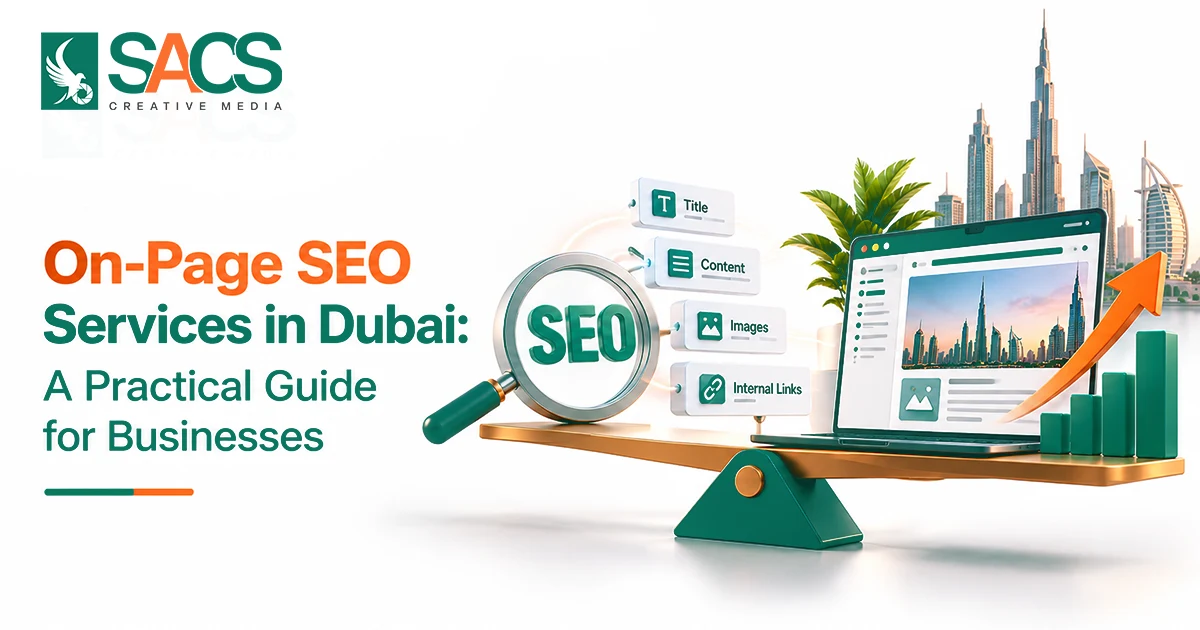
On-Page SEO Services in Dubai help businesses improve their website pages so search engines can understand their content and users can quickly find relevant information. Effective on-page SEO is not about repeating keywords. It is about creating clear, useful, well-structured pages that match what people are actually searching for.
A professional SEO Service in Dubai should focus on more than rankings. It should improve content relevance, page structure, headings, titles, internal links, images, user experience, and conversion opportunities. When these elements work together, businesses can attract more relevant organic traffic and generate better enquiries from search.
What Is On-Page SEO?
On-page SEO is the process of optimizing elements within a website to help individual pages perform better in search results. These elements include page titles, headings, content, URLs, images, internal links, metadata, and the overall organization of information.
The main goal is to make a page easy for both users and search engines to understand. A visitor should know what the page offers, whether it meets their needs, and what action they can take next.
For example, a service page should explain the service clearly, cover important customer questions, highlight relevant benefits, and provide a simple way to make an enquiry. A page created mainly by repeating a keyword offers much less value.
Why On-Page SEO Matters for Dubai Businesses
Dubai is a competitive market across real estate, hospitality, healthcare, technology, construction, and professional services. Businesses need website pages that clearly explain their services and match what potential customers search for.
On-Page SEO Services in Dubai improve key page elements such as content, titles, headings, internal links, URLs, and images. They also focus on search intent, which means understanding what users expect when they search.
For example, “what is technical SEO” requires an informative answer, while “technical SEO company in Dubai” shows stronger commercial intent. Creating content that matches these different needs makes pages more relevant and useful without relying on keyword repetition.
Important Elements of On-Page SEO
1. Keyword Research and Mapping
Keyword research identifies the words and phrases potential customers use when looking for a service, product, or solution. However, the objective is not to collect as many keywords as possible.
A better approach is to select one primary topic for each important page and use closely related terms where they improve the explanation. Keywords should also be mapped to the most relevant pages so that different URLs do not compete for exactly the same search intent.
This creates a clearer website structure and helps each page serve a specific purpose.
2. Page Titles and Meta Descriptions
The page title gives users and search engines an immediate indication of what a page covers. It should be clear, specific, and relevant to the primary topic.
Meta descriptions provide a short preview of the page in search results. Although they are not a direct ranking factor, a clear and useful description can encourage the right users to click.
Avoid adding multiple keyword variations simply to make a title appear more optimized. Clarity should come first.
3. Clear Heading Structure
Headings make content easier to scan and help organize information. The H1 should clearly identify the main topic, while H2 and H3 headings should divide the content into useful sections.
For a service page, headings might cover the service, benefits, process, applications, industries served, FAQs, and next steps. This structure helps visitors find answers without reading every paragraph.
4. Useful and Original Content
Content should answer real customer questions rather than exist only to increase word count. Visitors should be able to understand the service and make an informed decision from the information provided.
Useful content can include practical explanations, service details, examples, common problems, benefits, processes, FAQs, and factors customers should consider before choosing a provider.
Original business knowledge can make a page even more valuable. Project experience, real examples, case studies, photographs, and expert explanations can provide information that generic content cannot easily reproduce.
5. Internal Linking
Internal links connect relevant pages within a website. They help visitors discover additional information and help search engines understand the relationship between different topics.
For example, an SEO service page could link to relevant pages about technical SEO, local SEO, keyword research, content strategy, or SEO audits. Links should be added where they genuinely help the reader.
Using descriptive anchor text also gives users a better idea of what they will find after clicking.
6. Image Optimization
Images can improve the usefulness and visual quality of a page when they support the topic. Businesses should use relevant images, descriptive file names, suitable formats, and meaningful alt text.
Original photographs, project images, screenshots, diagrams, and other business-specific visuals can also strengthen credibility when they provide genuine context.
7. URL Optimization
A clear URL helps users understand what a page is about. URLs should generally be short, descriptive, and relevant to the page topic.
Avoid unnecessary words, confusing structures, and frequent URL changes. If an existing page already has search visibility or backlinks, changes should be planned carefully and supported with appropriate redirects.
How to Improve Existing Website Pages
Businesses do not always need to create new pages to improve organic performance. Existing pages may already have useful information but fail to perform because the content is outdated, poorly structured, or no longer matches search intent.
Start by identifying pages that receive impressions but few clicks, pages ranking just outside the top results, and important service pages receiving little organic traffic.
Then review the title, introduction, headings, content, internal links, images, FAQs, and calls to action. The objective should be to make the page more useful and relevant, not simply longer.
Effective On Page SEO Techniques can include improving content clarity, strengthening topic coverage, updating outdated information, refining internal links, and making important answers easier to find.
Common On-Page SEO Mistakes to Avoid
Keyword stuffing is one of the most common mistakes. Repeating the same phrase in every heading and paragraph can make content sound unnatural and reduce the quality of the reading experience.
Another problem is creating several pages that target almost identical search intent. When pages overlap heavily, it becomes harder to establish a clear purpose for each URL.
Other common issues include vague titles, weak introductions, thin service information, poor internal linking, missing image optimization, outdated content, and unclear calls to action.
Optimization should improve a page without making it feel artificially written for search engines.
How SACS Creative Media Approaches On-Page SEO
SACS Creative Media approaches on-page SEO by first understanding the business, its target audience, services, location, and search goals. This helps determine what each important page should communicate and which search intent it should satisfy.
The process can include keyword mapping, content evaluation, title and heading optimization, internal linking, image optimization, URL review, FAQ development, and improvements to conversion-focused sections.
Rather than using one template for every business, the focus is on making each page useful for its intended audience. Service pages should support enquiries, while informational content should provide clear answers and useful context.
For businesses investing in On-Page SEO Services in Dubai, this practical approach connects search optimization with real business objectives such as relevant traffic, qualified leads, calls, and sales.
How to Measure On-Page SEO Performance
On-page SEO should be monitored after changes are made. Rankings are useful, but they are only one part of measuring performance.
Google Search Console can show impressions, clicks, search queries, and average positions for individual pages. Analytics data can provide additional information about engagement, landing pages, and conversions.
For example, a page may receive many impressions but few clicks. This could indicate that the title or search-result description needs improvement. Another page may receive traffic but generate few enquiries, suggesting that its content, trust signals, or conversion path needs attention.
Regular monitoring helps businesses understand what is working and where further improvements are needed.
Practical On-Page SEO Checklist
Before publishing or updating an important website page, check the following:
- Does the page match the search intent?
- Is the main topic clear from the title and H1?
- Does the introduction answer the user’s need quickly?
- Is the content original and useful?
- Are related topics covered naturally?
- Are headings organized logically?
- Are internal links relevant?
- Are images optimized and descriptive?
- Is the URL clear?
- Does the page have a relevant call to action?
This checklist provides a practical starting point, but every website should be evaluated according to its industry, audience, competition, existing performance, and business goals.
Conclusion
On-Page SEO Services in Dubai are about making website pages clearer, more relevant, and more useful for people searching for a business. Strong optimization combines keyword research, search intent, helpful content, structured headings, internal linking, optimized images, and clear conversion paths.
For businesses competing in Dubai, improving important existing pages can be just as valuable as publishing new content. A good page should answer the user’s question quickly, explain the business clearly, build confidence, and make the next step easy.
The goal is not simply to make a website visible in Google. It is to create pages that deserve to be found, understood, visited, and trusted. That user-first approach gives businesses a stronger foundation for sustainable organic traffic and qualified leads.