Web Development Life Cycle is the structured process of planning, designing, developing, testing, launching, and maintaining a successful website. Following this process helps businesses reduce development mistakes, control project costs, improve user experience, and create a website that supports long-term business growth. Whether you are creating a small business website, an ecommerce store, a corporate platform, or a service-based website, having a clear development process can make the project more organized and effective.
For businesses operating in the UAE, choosing an experienced Website Design Company in Dubai can make website development smoother and more results-driven. Professional designers and developers can connect business objectives with modern design, responsive layouts, technical performance, SEO, security, and conversion-focused functionality. Instead of creating a website simply because every business needs one, the goal should be to build a digital platform that attracts the right audience and encourages visitors to take meaningful action.
What Is the Web Development Life Cycle?
The Web Development Life Cycle is a systematic approach used to take a website project from an initial idea to a fully functioning online platform. It covers everything from understanding business requirements and researching users to designing the interface, writing code, testing functionality, launching the website, and maintaining it after launch.
A structured process is important because website development involves several different areas of expertise. Designers focus on visual presentation and user experience. Developers handle functionality and technical implementation. Content teams prepare information for users. SEO specialists work on search visibility, while business owners focus on leads, sales, branding, and customer relationships.
Without proper coordination, these activities can conflict with each other. For example, a design may look impressive but load slowly. A website may have excellent content but poor navigation. A developer may build a feature that does not actually support the business objective.
A well-organized development process brings these areas together and gives everyone a clear direction.
Why Is a Structured Development Process Important?
A website is more than a collection of pages. It is often one of the most important touchpoints between a business and its customers.
Visitors expect websites to load quickly, work properly, look professional, and provide useful information. If a website is confusing or difficult to use, potential customers may leave before contacting the business.
A structured development process helps businesses:
- Define clear website objectives
- Understand their target audience
- Organize website content
- Create intuitive navigation
- Improve user experience
- Reduce technical errors
- Control development costs
- Improve website speed
- Strengthen website security
- Support SEO
- Create a scalable digital platform
- Improve conversions
The process also makes it easier to identify problems early. Fixing a problem during planning is usually much easier and cheaper than fixing it after the website has gone live.
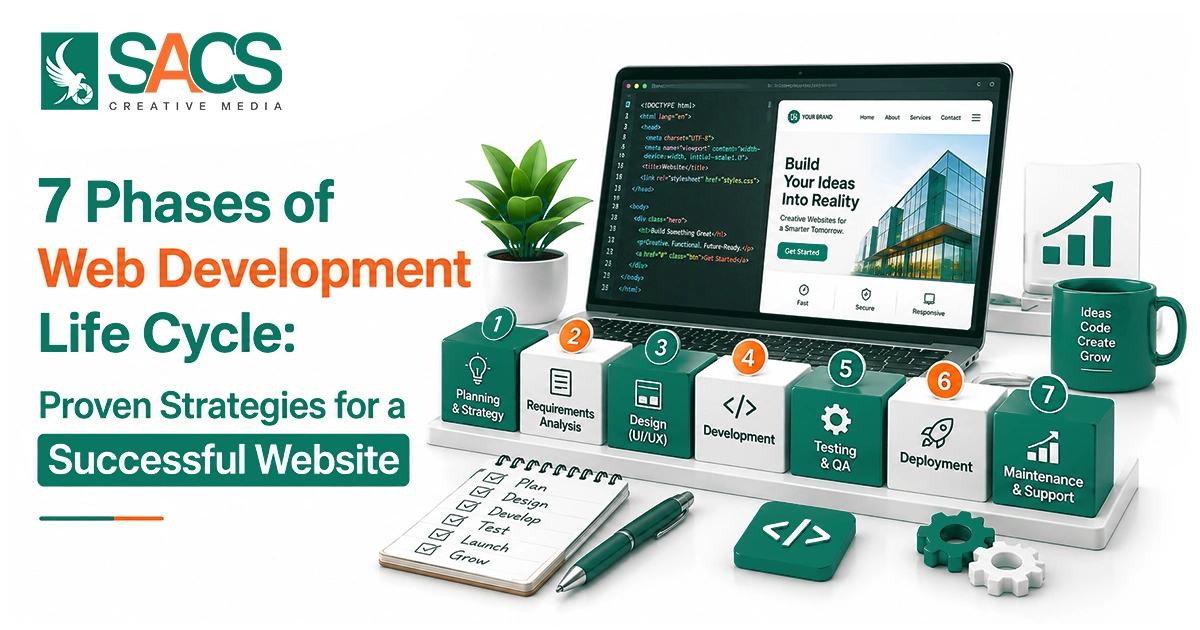
The 7 Phases of Web Development Life Cycle
The 7 Phases of Web Development Life Cycle provide a practical roadmap for turning a website idea into a functioning and sustainable digital platform. While agencies may use different names for individual stages, the basic principles remain similar.
Let’s explore each phase in detail.
1. Planning and Requirement Analysis
Planning is the first and one of the most important stages of website development.
Before designers create layouts or developers write code, the project requirements need to be clearly understood. The team should first determine what the website is expected to achieve.
For example, a business may want its website to:
- Generate qualified leads
- Increase online sales
- Promote services
- Improve brand awareness
- Receive appointment bookings
- Showcase a portfolio
- Provide customer information
- Support an advertising campaign
The target audience should also be identified.
A website designed for young consumers may have different messaging and visual preferences from a website targeting corporate decision-makers. Understanding the audience helps the team make better decisions about content, design, navigation, and functionality.
Competitor research is another important part of planning. Reviewing competing websites can help identify common features, content gaps, user expectations, and opportunities for differentiation.
The team should also determine:
- Required website pages
- Functional requirements
- Content requirements
- Technical requirements
- Third-party integrations
- Budget
- Development timeline
- SEO requirements
- Security requirements
A clear project scope is especially important. It prevents unnecessary features from being added during development and helps keep the project within budget.
2. Website Structure and Information Architecture
Once the requirements are clear, the next stage is organizing the website.
Information architecture determines how pages and information are arranged. It also defines how users move through the website.
A typical business website might include:
- Home
- About Us
- Services
- Individual Service Pages
- Portfolio
- Case Studies
- Blog
- Contact
- Privacy Policy
- Terms and Conditions
An ecommerce website may require a more complex structure involving product categories, product pages, filters, shopping carts, checkout pages, customer accounts, and order management.
A sitemap is useful at this stage because it provides a visual representation of the website structure.
Navigation should be simple. Important pages should be easy to reach without forcing visitors through unnecessary steps.
This phase also has SEO value. A logical website structure helps search engines understand the relationship between pages and identify important content.
Internal linking should be considered early rather than added randomly after launch. Related pages should be connected naturally so both users and search engines can discover relevant information.
A well-planned structure creates a strong foundation for design, development, and future content expansion.
3. UI and UX Design
After the website structure has been finalized, the project moves into the design phase.
UI stands for User Interface, while UX stands for User Experience.
UI focuses on how the website looks. UX focuses on how the website feels and functions when someone uses it.
A good website needs both.
An attractive design may capture attention, but it must also make it easy for users to find information and complete actions.
Designers often begin with wireframes. Wireframes provide a basic layout showing where navigation, headings, images, content, forms, buttons, and other important elements will be placed.
Once the structure is approved, the visual design can be developed.
Important Website Design Elements may include:
- Brand colors
- Typography
- Navigation menus
- Images
- Icons
- Buttons
- Forms
- Calls to action
- Testimonials
- Trust signals
- Content sections
Mobile responsiveness should be considered from the beginning rather than treated as a final adjustment.
A website should work comfortably on smartphones, tablets, laptops, and desktop computers.
Designers should also think about accessibility. Text should be readable, buttons should be easy to tap, color contrast should be appropriate, and important information should not be hidden behind complicated interactions.
Most importantly, each page should have a purpose.
A service page might encourage visitors to request a consultation. A product page might encourage a purchase. A contact page should make it easy to get in touch.
4. Website Development
After the design has been approved, developers begin turning the visual concepts into a working website.
This stage involves frontend development and, when required, backend development.
Frontend development focuses on what visitors see and interact with. Backend development manages systems behind the scenes, such as databases, accounts, forms, ecommerce functions, bookings, and integrations.
The technology used depends on the website’s requirements.
A simple business website may use a content management system, while a complex web application may require custom development.
Regardless of the technology, development should focus on performance, security, scalability, and maintainability.
Developers should ensure that:
- Pages load efficiently
- Navigation works correctly
- Forms function properly
- Buttons lead to the correct destinations
- Images display correctly
- The website works across devices
- Code is organized
- Security measures are implemented
SEO should also be considered during development.
Important technical areas can include URL structures, heading hierarchy, mobile responsiveness, page speed, crawlability, redirects, canonical tags, XML sitemaps, and structured data.
Building an SEO-friendly technical foundation from the beginning is more efficient than trying to repair major technical problems after launch.
5. Testing and Quality Assurance
One of the most important stages of the Web Development Life Cycle is testing.
A website should not go live simply because development has been completed.
Testing helps identify problems that may affect functionality, performance, security, usability, or search visibility.
Functional Testing
Every important function should be tested. This includes contact forms, menus, buttons, search functions, filters, booking systems, login features, shopping carts, and payment processes where applicable.
Mobile Testing
The website should be reviewed across different mobile screen sizes. Check whether text remains readable, buttons are easy to tap, menus work correctly, and images fit within the screen.
Browser Testing
Websites should be checked across commonly used browsers to identify layout or functionality problems.
Performance Testing
Large images, unnecessary scripts, excessive plugins, and inefficient code can slow down a website. Testing helps identify these issues so the development team can improve loading performance.
Security Testing
Security checks should include user permissions, login systems, software versions, forms, data handling, and other relevant security areas.
SEO Testing
Technical SEO should be reviewed before launch. Important checks include page titles, meta descriptions, heading structure, URLs, internal links, canonical tags, robots directives, XML sitemap, indexability, redirects, and structured data.
Content Testing
Content should be checked for spelling mistakes, broken links, missing images, formatting problems, and inaccurate information.
User testing can also be useful. People who were not involved in creating the website may notice confusing navigation or unclear messaging that the development team missed.
6. Website Launch and Deployment
Once testing is complete and major problems have been resolved, the website can be prepared for launch.
Deployment involves moving the website from the development environment to the live server.
Before launch, the team should complete a final checklist.
- Connecting the domain
- Configuring hosting
- Installing SSL
- Checking redirects
- Testing forms
- Connecting analytics
- Setting up search engine tools
- Checking robots.txt
- Submitting the sitemap
- Reviewing metadata
- Checking mobile responsiveness
- Testing page speed
- Creating backups
The launch should be treated as a controlled process.
Once the website becomes live, it should be monitored carefully. Some problems may only appear when real users interact with the website.
Analytics should be checked to understand visitor behavior, traffic sources, popular pages, engagement, and conversions.
Search performance should also be monitored for indexing problems or unexpected changes.
7. Maintenance and Continuous Optimization
The final stage of the Web Development Life Cycle is maintenance and continuous improvement.
Launching a website does not mean the project is permanently finished.
Technology changes. Search engines evolve. Customer expectations change. Competitors introduce new features. Security threats develop. Content becomes outdated.
For these reasons, websites require ongoing attention.
Regular maintenance may include:
- Software updates
- Security monitoring
- Website backups
- Broken-link checks
- Performance improvements
- Content updates
- SEO optimization
- Conversion optimization
- New functionality
- Analytics analysis
Website data can provide valuable insights.
For example, if a page receives significant traffic but generates very few enquiries, the page may need stronger messaging, clearer calls to action, better trust signals, or a simpler contact process.
Similarly, if mobile visitors leave a page quickly, the mobile experience should be investigated.
Continuous optimization allows businesses to improve the website based on real user behavior instead of assumptions.
Proven Strategies for Building a Successful Website
Following the 7 Phases of Web Development Life Cycle provides structure, but several additional strategies can improve the final outcome.
1. Start With Business Objectives
Every major website decision should connect to a business goal.
Avoid adding features simply because another company has them. Instead, determine whether a feature improves user experience or contributes to a measurable business objective.
2. Understand Your Audience
Your website should speak directly to the people you want to reach.
Understand their problems, questions, expectations, and buying behavior. Use clear language that helps them quickly understand what you offer and why they should choose you.
3. Focus on Website Speed
Speed has a direct impact on user experience.
Optimize images, minimize unnecessary scripts, use efficient hosting, and avoid installing features that do not provide real value.
A fast website creates a smoother experience and can support better engagement.
4. Prioritize Mobile Experience
Mobile users should not receive a second-rate version of the website.
Menus, forms, buttons, images, tables, and content should work naturally on smaller screens.
5. Include SEO From the Beginning
SEO should be considered during planning, not after the website is launched.
Keyword research, page structure, content organization, internal linking, URLs, technical SEO, and search accessibility should all be considered during development.
6. Build With Security in Mind
Security should be part of the development strategy.
Keep software updated, use secure connections, protect administrator access, maintain backups, and regularly monitor the website.
Websites that collect customer information or process payments require additional attention to security.
7. Track Conversions
Traffic alone does not tell you whether a website is successful.
Businesses should track meaningful actions such as contact form submissions, phone calls, quote requests, purchases, bookings, newsletter sign-ups, and downloads.
Conversion tracking makes it easier to understand whether the website is actually supporting business growth.
Common Website Development Mistakes to Avoid
Starting Without Clear Requirements
Beginning development without defining objectives often leads to changing requirements, delays, and additional costs.
Focusing Only on Visual Design
A beautiful website is not enough. It must also be fast, accessible, easy to navigate, secure, and useful.
Ignoring Mobile Users
A website that performs poorly on smartphones can lose potential customers.
Adding Too Many Features
More functionality does not always create more value. Unnecessary features can make a website complicated and slow.
Treating SEO as an Afterthought
Trying to fix major SEO issues after launch can require structural changes. SEO should be considered during planning and development.
Forgetting Maintenance
Websites need regular updates, monitoring, security checks, and optimization to remain effective.
How a Website Can Support Your Marketing Efforts
A website is often the central destination for digital marketing campaigns.
Search engines, social media platforms, email campaigns, online advertisements, and other channels can all send visitors to the website.
This makes it important to connect development with broader Website Marketing Strategies.
For example, an advertising campaign may require dedicated landing pages. An SEO campaign may require a strong content structure. Social media campaigns may direct visitors to service pages or product pages.
A well-developed website can support these channels by providing fast-loading pages, clear messaging, strong calls to action, and a smooth user experience.
Analytics can then help identify which marketing channels generate the most valuable visitors.
Final Thoughts
The Web Development Life Cycle provides a practical roadmap for creating a website that is functional, user-friendly, secure, and prepared for long-term growth.
The process starts with planning and requirements, moves through information architecture, design, development, testing, and launch, and continues with maintenance and optimization.
Each phase has a specific purpose, but the stages work together. A strong website structure supports better design. Good design supports better user experience. Clean development supports performance and SEO. Thorough testing reduces launch problems. Continuous optimization helps the website improve over time.
The key lesson is simple: a successful website should not be treated as a one-time project. It should be viewed as an evolving digital asset that supports business objectives.
By following a structured development process and focusing on real users, businesses can create websites that do more than look professional. They can attract the right audience, communicate value, generate enquiries, support marketing campaigns, and contribute to sustainable business growth.