Businesses can use different Types of Marketing Videos to attract new customers, explain products and services, answer common questions, and build trust. From short social media clips to customer testimonials, each format serves a different marketing purpose. Working with a professional video production company in Dubai can help businesses create content that fits their audience, brand, and marketing goals.
Video has become an important part of how people discover and evaluate businesses. A useful video can explain a complex service, demonstrate a product, introduce a company, or answer a question faster than a long block of text.
The key is choosing the right video for the right audience and purpose. Businesses do not need to create every type of video. Instead, they should focus on formats that match customer needs and support their marketing goals.
Why Are Marketing Videos Important for Businesses?
Customers often want clear information before making a decision. Video can show how something works, explain what a service includes, or give potential customers a better understanding of a business.
The Benefits of Video Marketing include stronger engagement, easier information delivery, better brand communication, and more opportunities to connect with audiences across websites, social media, search, and digital advertising.
Different videos also work at different stages of the customer journey. Someone discovering a brand may want to know who the company is, while someone ready to buy may want a product demonstration, testimonial, or case study.
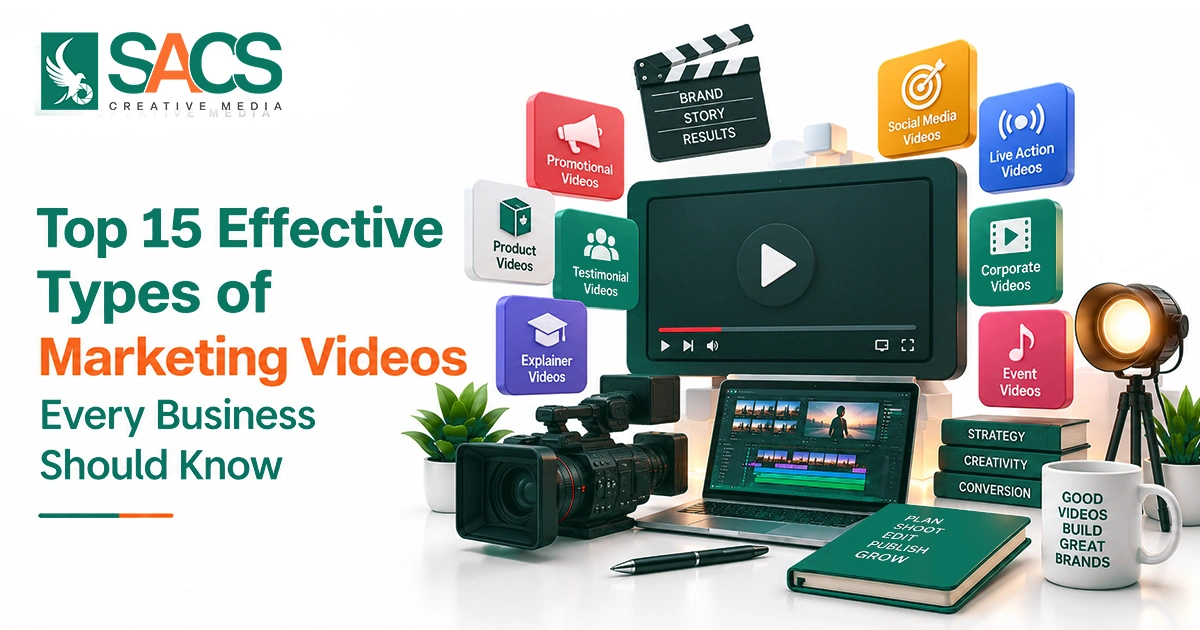
Here are the Top 15 Effective Types of Marketing Videos
1. Brand Story Videos
Brand story videos introduce a company’s purpose, people, values, and background. They help potential customers understand who is behind the business and what it offers.
A good brand video should answer simple questions: Who are you? What does your business do? What problem do you solve? What makes your business different?
These videos work well on homepages, About Us pages, LinkedIn, YouTube, and social media. The focus should be on the real story of the business rather than making the video feel like a long advertisement.
2. Product Demonstration Videos
Product demonstration videos show customers how a product works and why it is useful.
Instead of simply listing features, businesses can demonstrate the product in a real situation. This makes it easier for viewers to understand what they are buying.
These Types of Marketing Videos are particularly useful for ecommerce brands, technology companies, manufacturers, retailers, and businesses selling products that need some explanation.
A strong product demonstration should focus on the main product features, how the product works, the problem it solves, how customers can use it, and the key benefit. Keep the demonstration focused rather than trying to explain every small feature.
3. Customer Testimonial Videos
Customer testimonial videos allow real customers to share their experience with a company, product, or service.
A useful testimonial can explain what problem the customer had, why they chose the business, what their experience was like, and what result they achieved.
Real customer stories can answer concerns that potential buyers may have before contacting a business. Avoid making testimonials sound overly scripted. Natural answers and genuine experiences usually make the content easier to relate to.
For service businesses, testimonials can be particularly useful because they give potential customers an idea of what it is like to work with the company.
4. Explainer Videos
Explainer videos make a product, service, process, or complicated idea easier to understand.
They are useful for businesses offering technical, professional, or complex services. An explainer can combine live footage, animation, screen recordings, graphics, and voiceover.
The best approach is to focus on one main subject. For example, instead of explaining an entire software platform in one video, create a video that explains how one important feature solves a specific customer problem.
Clear explanations can help visitors understand an offer without having to read large amounts of information.
5. Tutorial and How-To Videos
Tutorial videos provide practical, step-by-step information. They are useful when customers need help using a product, completing a process, or solving a common problem.
Examples include how to use a product, how to install equipment, how to complete a process, how to use a software feature, how to maintain a product, and how to solve a common issue.
Tutorial content can also attract users who are actively searching for answers online. Keep each video focused on one question or task. Show each step clearly and avoid adding information that does not help the viewer complete the task.
6. Short-Form Social Media Videos
Short-form videos are designed for quick consumption on platforms such as Instagram, Facebook, TikTok, YouTube Shorts, and LinkedIn.
Businesses can create short videos around quick tips, product features, customer questions, industry facts, behind-the-scenes moments, short demonstrations, common mistakes, and simple educational points.
The opening seconds are important. Start with the main topic instead of a long introduction.
A longer video can also be turned into several short clips. This allows businesses to create more social media content from a single production.
7. Corporate Videos
Corporate videos introduce a company, team, services, facilities, culture, or capabilities.
They can be used for business websites, sales presentations, exhibitions, corporate events, LinkedIn, recruitment, and company presentations.
A simple corporate video structure is: Who we are → What we do → Who we serve → Why customers choose us → Next step.
The content should remain professional without becoming too formal. Customers usually want to understand what the company actually does and how it can help them.
8. Promotional Videos
Promotional videos focus on a specific product, service, offer, campaign, or event.
A good promotional video should quickly explain what is being offered, who it is for, the main benefit, why it matters, and what the viewer should do next.
These videos are often used for social media campaigns, digital advertising, websites, product launches, and seasonal promotions.
One common mistake is trying to promote too many things in one video. Keep the message focused on one main offer and one clear action.
9. Educational Videos
Educational videos provide useful information related to a business, industry, product, or service.
For example, a real estate company can explain the property buying process, a technology company can explain cybersecurity basics, a marketing agency can explain search marketing concepts, and a manufacturer can explain how its equipment works.
Educational videos can attract people who are researching a topic before they are ready to buy.
This makes them useful for building awareness and demonstrating knowledge without making every piece of content directly promotional.
10. Event Videos
Event videos capture conferences, exhibitions, corporate events, product launches, celebrations, and other important occasions.
Instead of recording every moment, focus on footage that tells the story of the event, including the venue, guests, speakers, audience reactions, networking, brand activities, and key moments.
Event footage can later be reused for social media clips, promotional campaigns, website content, and future event marketing.
This makes event production useful beyond the day of the event itself.
11. FAQ Videos
FAQ videos answer questions customers commonly ask before contacting or purchasing from a business.
Examples include: How does the service work? How long does the process take? What does the package include? What information do I need to provide?
Each video should focus on one question and provide a direct answer.
FAQ videos are especially useful for businesses that receive repeated questions from potential customers. They can also be added to relevant service or product pages to make important information easier to understand.
12. Case Study Videos
Case study videos explain how a business helped solve a customer’s specific problem.
A simple structure is: Challenge → Solution → Process → Result.
Where possible, include factual results such as increased enquiries, improved efficiency, reduced processing time, or other measurable outcomes.
Case studies are useful for agencies, consultants, technology providers, B2B companies, and professional service businesses.
Instead of simply saying that a company provides a good service, a case study shows how the service was actually applied to a real situation.
13. Behind-the-Scenes Videos
Behind-the-scenes videos show what happens behind the finished product or service.
Businesses can show team activities, product preparation, production processes, office culture, event preparation, creative work, and day-to-day operations.
This content can make a brand feel more human and approachable.
For example, a restaurant can show food preparation, a manufacturer can show part of its production process, and a creative agency can show how a campaign is developed.
The content does not need to be highly scripted. Genuine moments can often make these videos more interesting.
14. Recruitment Videos
Recruitment videos introduce a company to potential employees and show what it is like to work there.
They can feature employees, workplace environments, company culture, daily activities, career opportunities, and employee interviews.
Rather than simply describing the workplace, show real people and real activities.
Recruitment videos can be published on careers pages, LinkedIn, social media, and recruitment platforms to give potential candidates a better understanding of the company.
15. Live and Q&A Videos
Live videos allow businesses to communicate with their audience in real time.
They can be used for webinars, product launches, interviews, Q&A sessions, demonstrations, industry discussions, and educational sessions.
The main advantage is direct interaction. Viewers can ask questions and receive answers during the session.
A live session can also create additional content after the broadcast. Useful sections can be edited into short clips, educational videos, or social media posts.
How to Choose the Right Marketing Video
Choosing from different Types of Marketing Videos should start with the customer’s needs.
If people are discovering your business, brand story, educational, and short-form videos can introduce your company and explain what you offer.
If customers are researching a product or service, demonstrations, explainers, tutorials, FAQs, and case studies can provide more detailed information.
If they are close to making a decision, testimonials, demonstrations, case studies, and promotional videos can help answer final questions.
Before producing a video, consider who will watch it, what problem it solves, what question it answers, where it will be published, what information the viewer needs, and what the viewer should do next.
These questions help keep the video focused and useful instead of creating content without a clear purpose.
Choosing the Right Video Production Approach
Different subjects require different production styles. Product videos may need close-up shots and demonstrations, while corporate videos may require interviews and workplace footage.
Businesses should also consider the Types of Videography needed for their project, such as corporate filming, event coverage, product videography, interviews, promotional content, or social media production.
The production approach should support the message rather than distract from it.
Good lighting, clear audio, suitable framing, and clean editing can make a major difference. However, the most important factor is still the usefulness of the content.
Conclusion
The most effective Types of Marketing Videos are those that answer a genuine customer need. A product demonstration can show how something works, a testimonial can provide social proof, a tutorial can solve a problem, and an educational video can explain an important topic.
Businesses do not need to use every format. Start with the questions customers ask most often and the parts of the buying journey where better information is needed.
With clear planning and useful content, video can become a practical part of a business’s marketing strategy, helping audiences understand the brand, services, products, and value more quickly.